Digital Vérité, Part 2: Forensic Architecture and Animating the Killing of Mark Duggan
In Part 1, I introduced Digital Vérité — a framing of documentary image-making practices that assert their truth claims specifically through the use and application of digital tools. I argued that this rhymes with cinema vérité's earlier technological truth claim, and that the same scepticism should be attached to it. This second part works through that scepticism via a case study.
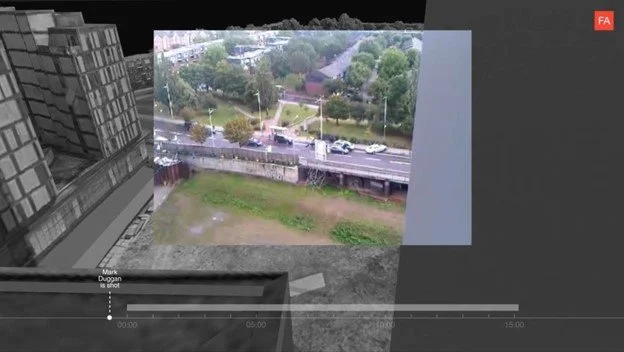
Fig.1 - The Killing of Mark Duggan (2020).
On 4 August 2011, Metropolitan Police officers shot and killed Mark Duggan during a hard stop in Tottenham, north London. The subsequent inquest verdict of lawful killing rested on a contested account of the few seconds between the vehicle stopping and the fatal shots, specifically whether Duggan had drawn a weapon. The case triggered the Tottenham riots and remains one of the most disputed instances of fatal police violence in recent British history.
There was footage — a resident in a nearby tower block filmed the encounter from a distance. But the image’s resolution is too degraded and the angle too oblique to establish the precise sequence of movements. The video circulates, yet fails to resolve the question it ostensibly should answer (‘should’ in the sense of its purpose when taken up in a discursive framing). In evidentiary terms, it is not actionable in and of itself.
This is exactly the kind of failure that demands digital forensic image-making (Fig. 1). Forensic Architecture, the research agency directed by Eyal Weizman at Goldsmiths, took on the Duggan investigation in 2020 — commissioned by Duggan's family and timed to coincide with renewed calls for the inquest to be reopened.
Founded in 2010, Forensic Architecture investigates state violence, war crimes, and environmental harm; their portfolio spans the bombing of hospitals in Gaza, drone strikes in Syria and Yemen, the Grenfell Tower fire, and a growing number of police killings. The work appears in two registers simultaneously: submitted as evidence in courts, tribunals, and inquests, and exhibited in art biennales, museums, and documentary festivals. This dual circulation in juridical and artistic contexts is constitutive of their practice — the aesthetic and the evidentiary doing work for each other. The Duggan investigation contributes to this growing computational archive of state killing.
The investigation begins with a bird’s-eye spatial reconstruction of the shooting site, rendered in muted grey tones, with the figures of the officers and Duggan highlighted and the bullet's trajectory traced in red (Fig. 2). The view is from a position no camera and no witness ever occupied. The model is not a photograph; it is a construction drawn from an aggregation of evidence — police reports, IPCC documents, pathology findings, witness testimonies, the phone footage itself, and the measured geometry of the site. In Latour's terms, this is an inscription device: an image whose authority comes not from indexical correspondence to reality but from its mobility, combinability, and capacity to be brought into legal forums and overlaid with new data. The phone footage was locked in place; the model can transcend those constraints and reach greater evidentiary potentials.
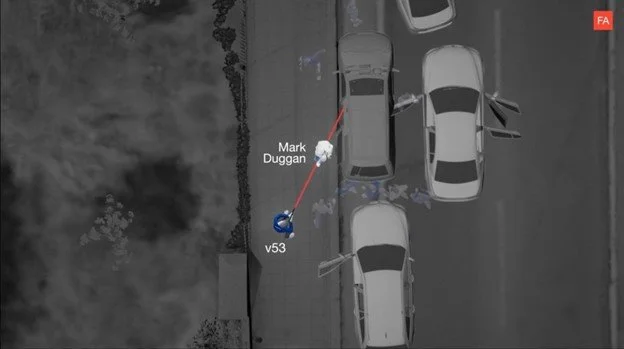
Fig. 2 The Killing of Mark Duggan.
The investigators make their own methodology visible throughout. Techniques like photogrammetry are named in voiceover. Footage is included of researchers in the field capturing spatial data. At one point, the investigation shows researchers wearing VR headsets, virtually occupying the positions of the police officers at the moment of the shooting — the camera showing both the body in physical space and the rendered digital environment on the screen behind. The investigator is visibly present, visibly constructing.
This is where Annabelle Honess Roe’s framing becomes generative (2017). The artifice is foregrounded rather than hidden, asking the viewer to assess a situated construction rather than to receive a transparent record. Donna Haraway’s account of scientific objectivity describes this as claiming a "view from nowhere" (what she called the ‘god trick’) — a view which always turns out, on inspection, to be from a particular somewhere whose particularity has been strategically hidden. Her counter-proposal was situated knowledge "answerable for what we learn how to see." The investigator with the VR headset is, in this sense, working against the god trick: the digital tools construct the image, but the construction is shown rather than concealed. The truth being produced is situated, and the viewer is being told where it is situated from rather than being positioned as a recipient of a revealed truth.
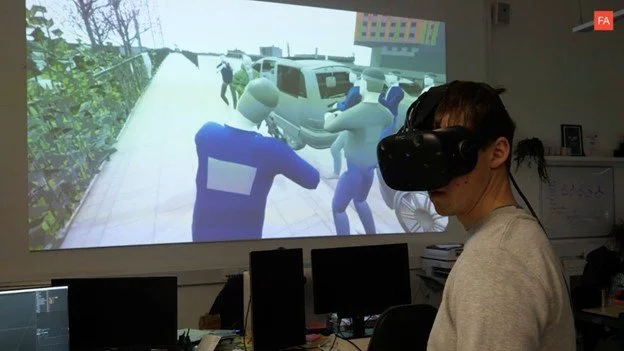
Fig. 3 - The Killing of Mark Duggan.
The Duggan investigation is also productive for tracing where this reflexivity meets its limits. After building the spatial reconstruction, investigators run a series of speculative scenarios: given the reconstructed positions of the officers and Duggan, is it physically possible that he was holding a firearm in the way the officers described? The scenarios test the evidentiary basis of the lawful killing verdict directly, modelling what could and could not have happened.
The visual language of the speculative scenarios is continuous with that of the reconstruction. There is no hard formal break between the image that says this is what the evidence shows and the image that says this is what the evidence makes impossible, or by extension possible. The voiceover maintains the distinction, but the image itself does not. The viewer is asked to hold two epistemic registers, reconstruction and speculation, within a single visual idiom (Fig. 3).
This is an issue Matthew Fuller and Eyal Weizman themselves raise in Investigative Aesthetics (2021): computational tools can reify the very systems they critique. The Honess Roe framing helps us notice what is being declared as artifice and what is quietly not — the construction of the reconstruction is declared, but the speculative status of the scenarios that follow is not.
There is also a broader question about purpose. Ryan Watson, writing on militant evidence in the digital age, argues that even devastating footage of police violence — the Rodney King tape is his central example — does not produce justice without the institutional and discursive scaffolding to make its force actionable. What matters, Watson argues, is "accumulated, targeted, and deployed" evidence, not the single revelatory image. The 3D model of the Duggan shooting did not overturn the inquest verdict. It produced a methodologically transparent counter-narrative, but it remains a counter-narrative whose political work depends on what campaigners, courts, and publics do with it.
It’s also productive to ask what justice is even speculatively imagined in this production. Forensic Architecture are implicitly reaching for the legitimacy of a juridical system itself weighted against their desired judgement. What amount of computational precision will transcend the structural oppression perpetuated by a justice system responsible for what they intend to investigate? The investigation makes little mention of the structures of racial bias endemic to the UK police, and little attention is given to the embodied experience of Duggan as a Black man — instead rendering his body as a sensor ontologically equal to the VR headset that allowed investigators to view his killing. This isn't to suggest the pursuit is fruitless, but to critically question what justice should look like when engaging in reconstructive truth production.
So what does this case bring into view about digital vérité?
Digital vérité is an analytical framework — a way of reading documentary practices that make their truth claims through digital tools. Applying that lens to the Duggan case suggests what the framework needs to hold together: a distinction between the rigour of a computational method and the rigour of the conclusions drawn from it, attention to where reflexivity is and isn't applied within a single visual idiom, and a sense of how such work depends on the institutional and discursive scaffolding that determines whether, and where, it can travel.
Johanna Drucker’s concept of graphesis is useful here. “All images,” she writes, “are encoded by their technologies of production” (2014: 23). The 3D model is no more constructed than the photograph; it is just constructed differently, and less familiarly. Familiarity has been doing a lot of work in the photograph's favour for over a century. Unfamiliarity is now doing the same work for the model, with viewers liable to mistake the strangeness of computational images for scientific objectivity.
Digital vérité, as a framework, inherits from cinema vérité the scepticism that any truth claim made through technology has always demanded — especially when the technology blurs the bounds of synthetic and authentic.
**Article published: June 19, 2026**
Bibliography:
Drucker, Johanna. 2014. Graphesis: Visual Forms of Knowledge Production. Cambridge: Harvard University Press.
Fuller, Matthew, and Eyal Weizman, 2021. Investigative Aesthetics: Conflicts and Commons in the Politics of Truth. London: Verso.
Haraway, Donna. 1988. “Situated Knowledges: The Science Question in Feminism and the Privilege of Partial Perspective.” Feminist Studies 14, no. 3 (Autumn): 575–599.
Honess Roe, Annabelle. 2017. “Interjections and Connections: The Critical Potential of Animated Segments in Live Action Documentary.” animation: an interdisciplinary journal 12, no. 3: 272–286.
Latour, Bruno. 1986. “Visualization and cognition: Drawing things together.” In H. Kuklick (ed.), Knowledge and Society: Studies in the Sociology of Culture Past and Present Vol. 6: 1–40. Stamford: Jai Press
Watson, Ryan. 2021. Radical Documentary and Global Crises: Militant Evidence in the Digital Age. Bloomington: Indiana University Press.
Biography
Isaac Parkinson is a PhD candidate in Digital Humanities at King’s College London. His research explores the interdisciplinary intersections of data visualisation, knowledge production, and documentary aesthetics in digital image cultures, focusing particularly on OSINT visual investigations and the documentation of human rights abuse.