The post-Spiderverse boom: New developmental styles in the Hollywood computer-animated film - Part 3
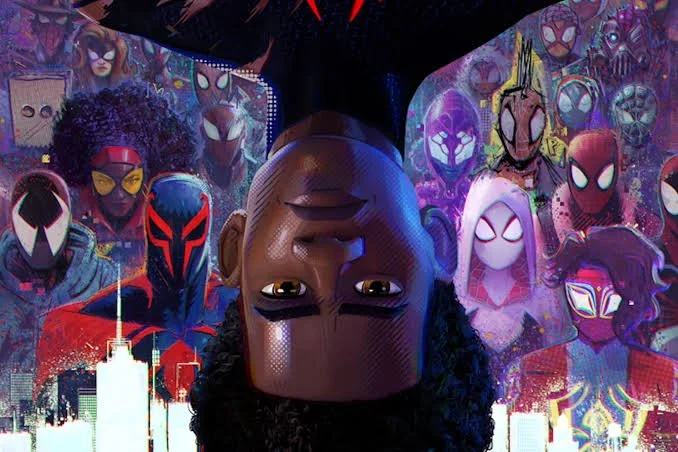
Fig. 1 - Spider Man: Across the Spider-Verse (Joaquim Dos Santos, Kemp Powers & Justin K. Thompson, 2023).
***This post was written in collaboration with Lucy Scarrow and Minxi Zheng***
As discussed in our two most recent blog posts, Hollywood mainstream studio computer-animation post-Spider-Verse has shifted from Pixar’s photorealistic aesthetic towards a more developmental style. Sam Summers argues that Sony’s franchise adapted the comic-book language itself (2019, 190), creating an aesthetic including Ben-Day dots and visible ink lines. The franchise transformed the genre’s “visual currencies” (Holliday 2018, 1) which Spider Man: Across the Spider-Verse (Joaquim Dos Santos, Kemp Powers & Justin K. Thompson, 2023) has only pushed further. Each world has a unique style: Miguel’s futurism, Spot’s minimalism, Gwen’s painterly, Spider-Punk’s collage, and Prabhakar’s is inspired by Indrajal Comics.
While early computer-animated films replaced hand-drawn practices with digital technologies (Holliday 2018, 3), Across the Spider-Verse wishes to return to animation’s hand-drawn origins through comic-book linework and watercolour textures (Fig. 1). The opening establishes the film’s individuality by incorporating experimental techniques like abstraction and multiple styles (Wells 1998, 59-61). The film is not simply experimental but developmental, including orthodox aspects like continuity, a plausible narrative and identifiable figures.
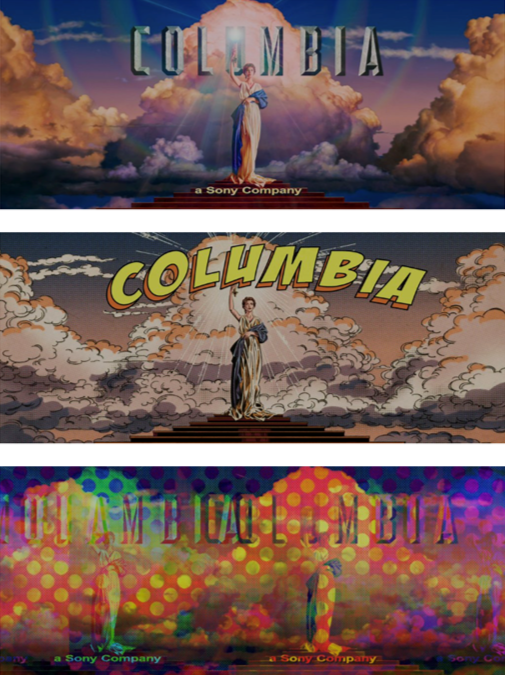
Fig. 2 - Columbia’s title sequence in multiple styles.
The animators expand the range of styles and recognisable “visual currencies and formal attributes” of the computer-animated genre (Holliday 2018,1). Even the title sequence (Fig. 2) “prioritises abstract forms in motion” (Wells 1998, 60) as pixel-like shapes and non-objective lines visualise the digital creation process and destabilise the traditional Columbia logo with glitches, clashing neon colours, and flattened perspectives. We see hand-drawn effects such as the linework detail on the clouds and the use of a comic-book style on the Columbia logo, designed in bold capital letters. Abstract shapes and intersecting lines with clashing colours showcase the imperfections of artistry in a visually alluring sequence. Within its first minute, the film distances itself from previous Hollywood computer animation by expanding the medium's formal attributes, employing experimental abstraction and multiple styles. Gwen Stacy’s world is especially developmental, using interpretive form and the presence of the artist (Wells 1998, 59-61). The film opens from Gwen’s perspective rather than Miles’, introducing her stylistic world into the franchise (Fig. 3). Gwen is a drummer, and the animators created a visual rhythm, focusing on the drumbeat’s rhythm to drive the movement rather than dialogue. In the first ten-minute sequence, multi-coloured rings appear in time with the drumstick in a music video style, creating a rhythm of movement of shapes, characters and letters.
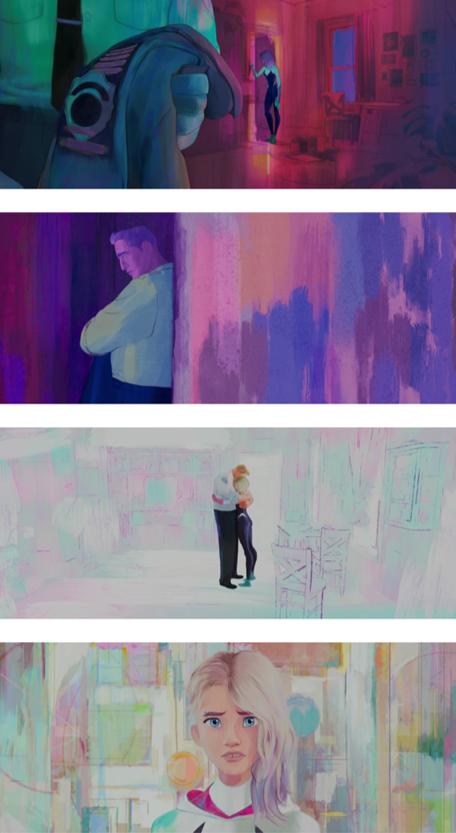
Fig. 3 - Gwen’s painterly world.
The use of developmental styles, which place emphasis on the artist, allows for animation to “represent inarticulable personal feelings” (Wells 1998, 61) and visualise Gwen’s complex, fluctuating emotions. The animators used a painterly aesthetic and a different colour palette to other worlds, including cyan, violet and orange. Marc-André Davignon and Bret St. Clair explore the technological innovation required for this painterly style, which notably deviates from Wells’ definition of orthodox animation, where the artist must be absent (Wells 1998, 54). Building upon the ‘Patcher tool’ from the first film, Across the Spider-Verse implemented new tools such as scanned textured brush strokes which are given individual attributes, to create the material painterly feel (Davignon and St. Clair 2023, 1-2).
The presence of the artist is seen in Across the Spider-Verse through brush strokes and linework, most notably in Gwen Stacy’s world. The hand of the artist is also seen through Miles Morales, who draws and creates his own suit. We see the marker lines and outlines in his drawings, appearing on paper in the animated world and come to life on screen. However, the most painterly sequence occurs after a fight sequence in Nueva York as Gwen returns home to her father.
In this emotional sequence, the living room becomes a canvas that parallels Gwen’s constantly changing feelings. Red and blue splashes and splotches of colour bleed vertically on the screen's canvas, creating a wet, tangible effect. As her father reveals he quit his job, the setting becomes surrealist, and the narrative is told through “vocabulary used by painters and sculptors” (Wells 1998, 60). Like the surrealist work of Joan Miró, non-objective multi-coloured lines interlink and cross over blue semicircles and red rectangles. The living room setting can barely be discerned. Shapes float and move in the air in an expressionistic manner, communicating Gwen’s complex internal state. This is the antithesis of scenes in Spot’s world which is minimalist, designed with only black and white doodles and pencil lines. When the two characters reconcile and hug, the background becomes lighter and paler. The light blue, pink and white colours are complementary, paralleling how she feels at peace and comfortable in her father’s arms. The objects behind become discernible as she feels less alienated. The paintbrush strokes continue to drip down the screen, but the colour palette is calmer as the scene is resolved.
Across the Spider-Verse’s painterly aesthetic.
Like the use of “leakage” (Wood 2007, 2) in Puss in Boots, Across the Spider-Verse uses experimental techniques to showcase the artistry of animation. The film is visually alluring, combining hand-drawn aesthetics, watercolour effects, abstract shapes and detailed linework to pay tribute to its comic-book influences. These developmental styles visualise complex internal feelings and let diverse stories be told, as each world represents specific cultures and identities. For Rosalind Murphy, the film’s technological experimentation becomes a form of “cultural resistance”, challenging dominant narratives in animation and “reimagin[ing] identity” (2026, 643-644). Therefore, the use of fragmented, multicultural styles across different worlds not only matches the multiverse narrative but also allows for animation to “imagine inclusive, culturally resonant futures” (Murphy 2026, 643) and expand the representation of marginalised identities, something which orthodox animation could not capture as effectively.
From our studio-based overview, we can conclude that the Hollywood computer-animated film experienced a stylistic change post-Spider-Verse. Due to its use of developmental styles and a playful aesthetic, Spider-Man: Into the Spider-Verse (Bob Persichetti, Peter Ramsey & Rodney Rothman, 2018) changed the possibilities of what a Hollywood computer-animated film could be. Like Toy Story (John Lasseter, 1995), the film facilitated a notable shift in style within the entire computer-animated genre, not just at Sony.
The analysis of Pixar’s Soul (Pete Docter, 2020) and DreamWorks’ Puss in Boots: The Last Wish (Joel Crawford, 2023) in previous weeks, and Spider-Man: Across the Spider-Verse this week, prove that a new developmental approach to computer-animation was popularised across Hollywood studios. These films play upon animation’s medium specificity, communicating complex internal feelings and emotions through visual style (penetration) as well as exploring marginalised identities, which are often simplified and stereotyped in mainstream animation. In these three posts, we have explored the incorporation developmental styles, such as multiple styles, materiality and the presence of the artist, to argue the ways mainstream animation is permitted to experiment, whilst remaining commercially successful and consumable for audiences.
It is uncertain whether these developmental changes will continue in Hollywood studio animation, or if this shift was just a short-term trend due to Sony’s success. We can hope that the franchise's third instalment will push Paul Wells' categories of orthodox and experimental even further and subvert the expectations of the computer-animation genre. However, as Pixar CEO Pete Docter recently said “We’re making a movie, not hundreds of millions of dollars of therapy" (qtd. in Pulver 2026), it is difficult to predict if studios will continue to subvert expectations or revert back to the “Pixar aesthetic” of early computer-animation.
However, we must conclude by celebrating human creativity and the incredible imaginative worlds these animators have created. These films align themselves more with animation as an art form and a laborious, complex practice, rather than a form generated by technology, something smoothed out, hyperrealised and conventional. We hope future Hollywood computer-animated films will continue to remain unpredictable and subvert generic expectations.
**Article published: October 16, 2026**
References
Davignon, Marc-André, and Bret St. Clair. 2023. “Non-photorealistic Compositing of the Spider-Verse: Showing the Hand of the Artist Without Painting Every Pixel.” SIGGRAPH '23: ACM SIGGRAPH 2023 Talks, available at: https://dl.acm.org/doi/10.1145/3587421.3595463.
Holliday, Christopher. 2018. The Computer-Animated Film: Industry, Style and Genre. Edinburgh: Edinburgh University Press.
Murphy, Rosalind. 2026. “Cinematic Futures: Afrofuturist Animation, Immersive Technologies, and Black Speculative Joy.” The Kyoto Conference on Arts, Media & Culture 2025: Official Conference Proceedings: 643-650.
Pulver, Andrew. 2026. “Pixar Chief Says LGBTQ+ Plot Elements Cut from Elio as Company Is ‘Not Making Therapy.’” The Guardian (March 9, 2026), available at: www.theguardian.com/film/2026/mar/09/pixar-chief-lgbtq-plot-cut-elio-not-therapy-pete-docter.
Summers, Sam. 2019. “Adapting a Retro Comic Aesthetic with Spider-Man: Into the Spider-Verse.” Adaptation 12, no. 2: 190-194.
Wells, Paul. 1998. Understanding Animation. London: Routledge.
Wood, Aylish. 2007. Digital Encounters. London: Routledge.
Biography
Rachel Reilly recently graduated from King's College London with a degree in Liberal Arts, majoring in Modern Languages. She studied interdisciplinary modules across Film Studies, Animation, Spanish and Comparative Literature. Through her studies and her work across West End and regional London theatres, she has developed a fascination with how stories come to life visually, from the stage to the screen.