
The post-Spiderverse boom: New developmental styles in the Hollywood computer-animated film - Part 1
***This post was written in collaboration with Rachel Reilly and Lucy Scarrow***
For many decades, mainstream animation has maintained a relatively uniform visual identity. Following the release of Pixar’s 1995 debut film Toy Story (John Lasseter, 1995), a dominant visual style emerged within computer-generated filmmaking, as major animation studios began to adopt a shared set of stylistic conventions, resulting in films that appeared similar (Holliday 2018, 1). However, in 2018, mainstream animation experienced a notable shift in both its aesthetic and industrial priorities following the release of Sony’s Spider-Man: Into the Spider-Verse (Bob Persichetti, Peter Ramsey & Rodney Rothman, 2018). The film achieved both critical acclaim and box office success, being widely praised for its distinct visual style and its use of animation as a medium to enhance storytelling. Traditionally, mainstream animated films have followed an orthodox form, which is a mode that, despite depicting fantastical or exaggerated events, adheres to conventional narrative structures and realist frameworks (Wells 1998, 51). While post-Spider-Verse films continue to employ realist narrative structures, stylistically, studios have implemented a distinct shift, as films no longer feel the same as their predecessors. In this essay, we argue that Spider-Verse led to a key turning point in the evolution of major animation studios' visual and formal language, prompting a move toward what Wells describes as “developmental animation,” a blend between orthodox and experimental forms. Beyond visual composition, recent computer-animated films also challenge canonical, dominant ‘hyperreal’ storytelling; by focusing on more abstract, internal and complex concepts such as race, identity, youth, mortality and mental health.
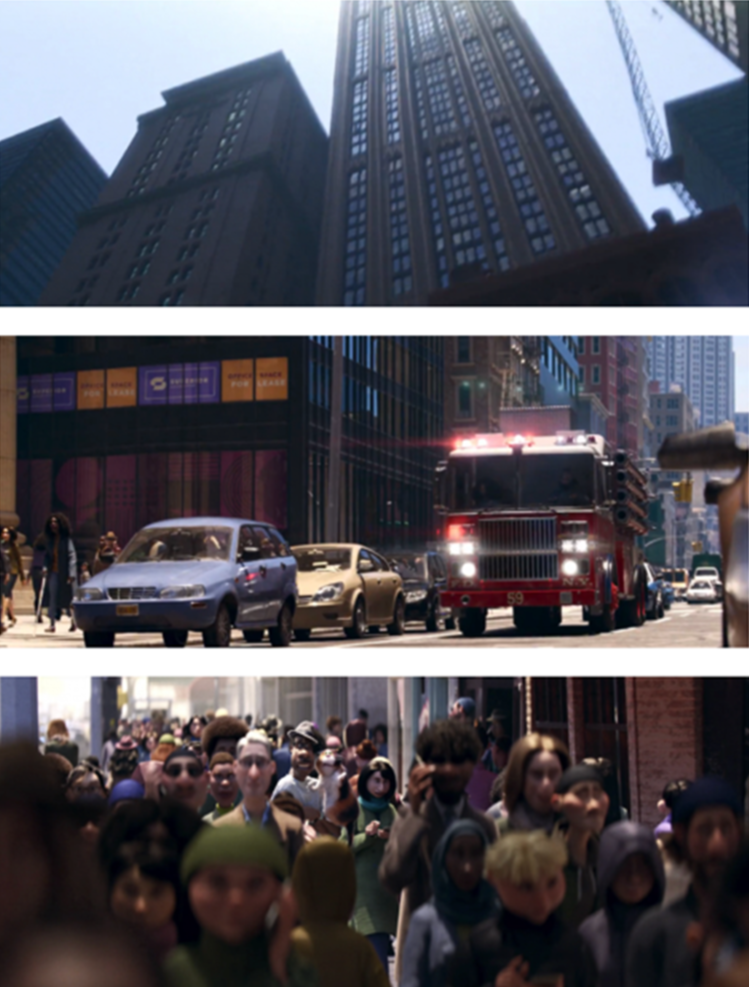
Fig. 1 - Soul’s New York City.
This will be the first blog post of three which explores a studio-based overview of the stylistic and narrative shift occurring in mainstream studio computer-animated films. In this post we will analyse Pixar’s Soul (Pete Docter, 2020), then next week we will consider DreamWorks' Puss in Boots: The Last Wish (Joel Crawford, 2023) before concluding with Sony’s Spider-Verse sequel Spider-Man: Across the Spider-Verse (Joaquim Dos Santos, Kemp Powers & Justin K. Thompson, 2023). Throughout these posts, we will demonstrate that there is a trend amongst several mainstream Hollywood studios of increasingly adopting a developmental style, departing from earlier orthodox formulas and, most importantly, expanding the thematic and aesthetic possibilities of contemporary animation.
As one of Pixar's earlier forays into this post-Spider-Verse stylistic expansion, Soul is notable for how it selectively abstracts spatial and character designs to partially loosen the studio’s unified and advanced computer-generated imagery. The film follows Joe Gardner, a music teacher navigating between the physical world and a metaphysical realm in search of life’s meaning - a journey through which complex existential experience is aesthetically translated into a commercially viable narrative within mainstream animation.
According to Eric Herhuth, Pixar films tend to employ “stylised realism” to construct animated environments that, despite their high degree of artistic mediation, retain the operational logic of contemporary life and invite audiences to perceptually believe this fabricated reality (2017, 1-14). Rather than marking a complete break from this Pixar tradition, Soul initially works from within it through its technological rendering of New York. For example, there are moments where the glare of sunlight across skyscrapers and glass facades, street-level compositions of traffic receding into depth, combined with the iconic density of the pedestrian flow (Fig.1). By endowing its cityscape with shadows and surface textures that approximate the tangible substance of the everyday world, while emulating lens-based, cinematographic techniques, Soul encourages audiences to intuitively accept its geographical legibility. Besides creating a fast-paced urban setting, the film consolidates this photorealism through the protagonists’ and passengers’ true-to-life clothing, actions, and weary faces, depicting the metropolis as a lived, ordinary place with which audiences can empathise. Although these illustrations appear consistent and echo Wells’ definition of orthodox animation that has a unified style (1998, 37), the film soon interrupts this aesthetic continuity in both Pixar and the film and moves toward a developmental representation as Joe transfers to the Great Beyond.

Fig. 2 - The Great Beyond.
As this sudden shift takes place, the frame is overtaken by an overwhelming blackness that induces immediate weightlessness and isolation; simultaneously, his body sheds its skeletal solidity and dissolves into a fluid, translucent form suffused with a blue-green luminescence, marking a stark visual contrast between the two domains (Fig. 2). Though these astral figures depart from Pixar’s established character paradigm and abandon naturalistic bodily physics, they keep readable human traits, instead occupying a position adjacent to normative delineation while deliberately unsettling its visual stability (Fong and Watral 2020). This soft, rounded intermediary form diffuses the horror that near-death might otherwise provoke, recasting Joe as an endearing soul physique that signals not finality but a potential opportunity to rediscover life, drawing audiences into closer understanding of his subsequent psychological transformation.
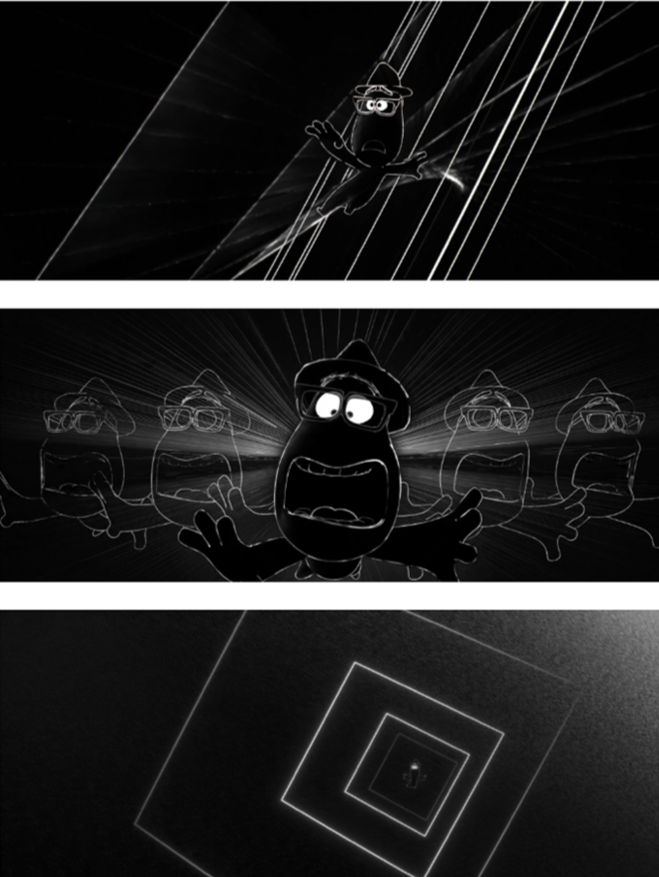
Fig. 3 - The transition to graphic abstraction.
Additionally, as Joe plummets from the Great Beyond into the Great Before, the visuals push further toward graphic abstraction through elements such as black-and-white silhouettes, radiating strokes, and repetitive geometric frames, as though entering another dimensional order composed entirely of points and lines (Fig. 3). Accompanied by ethereal, rhythmically punctuated electronic tones, a two-dimensional Joe becomes layered within a three-dimensional passage structured by velocity and geometry, as though absorbed into a process of recoding. The emphasis here lies no longer in conveying information through conservative modes such as direct dialogues, but in allowing sound patterning and visual shapes to evolve autonomously, immersing spectators in the sensations of being extracted and drawn into another plane of existence - qualities that lean toward experimental animation’s focus on musicality and materiality (Wells 1998, 45-46). Nevertheless, this sequence never fully breaks from the film’s linear narrative: Joe’s terrified facial expressions suggest his struggle, whilst the continuous downward trajectory implies his movement toward an unknown destination. This anchors the visual instability to his disorientation rather than collapsing into pure formalism, further rewriting near-death as an externalised, subjective state open to the audience’s imaginative projection.
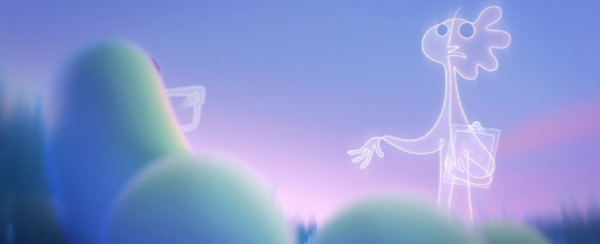
Fig. 4 - The Great Before.
Rather than sustaining this minimalistic, monochromatic vocabulary, Soul recalibrates as Joe arrives at the Great Before, folding the preceding abstraction into a more soothing visual language attuned to a broadly accessible aesthetics. Through integrating its colourful, expansive landscape with gentle music and children’s laughter, this setting coalesces into a nursery-like, emotionally consoling spectacle that tempers a sense of strangeness and instead becomes filled with innocence and optimism (Fig. 4). Yet the film’s design does not forfeit its experimental impulse even as it maintains a harmonious and sensorily appealing atmosphere: characters such as Jerry and Terry are made through cubist, disembodied, and ever-changing forms, keeping concepts of the cosmos and the origin of life irreducibly elusive, beyond the reach of materialisation. Drawing inspiration from nature and Swedish sculptures, the film crew conceives these figures as “a living line”, developing a new animated system through gesture, expression, and metamorphosis without referring to any ready-made models (Pollock 2020). Even though the audience may not identify them as recognisable humans or creatures within an orthodox animation structure (Wells 1998, 36), Soul manages to domesticate these visually heterogeneous designs into narratively functional personas through distinctive human voices and temperaments. For example, when Terry enters New York in pursuit of Joe and 22, the film keeps it rendered in luminous strokes embedded against graffiti and traffic lights as though a transient graphic inscription occupying the fabric of the physical realm (Fig. 5). Merged with a sly, masculine dubbing, this juxtaposition of abstract lines and hyperrealistic style is naturalised by Terry's agile and exacting nature, adding tension and humour to the chase in ways that make two incompatible dimensions feel coherent.
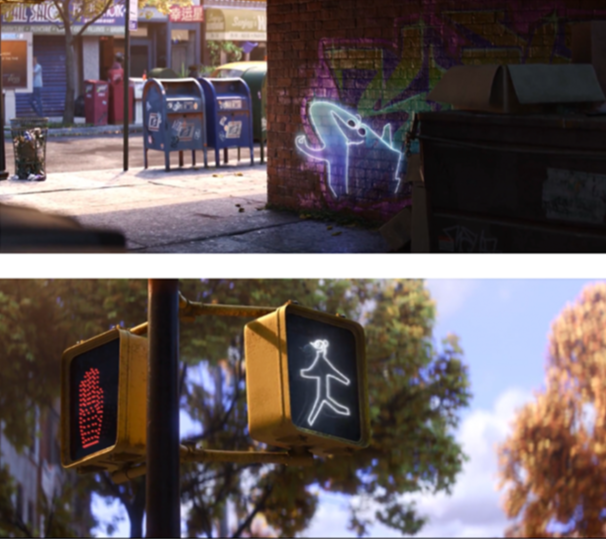
Fig. 5 - Terry.
Hence, Soul remains grounded in the framework of orthodox animation while developmentally introducing abstraction, extending Pixar’s visual boundaries while giving visible form to metaphysical experiences that are difficult to portray, without losing the entertaining and affective features of mass-oriented works.
In next week’s blog post we will explore another computer-animated film from a different studio to analyse how it also departs from a purely orthodox computer-animated style. DreamWorks’ Puss in Boots: The Last Wish diverges from the 3D hyperrealism of the other Shrek films in the franchise, offering audiences developmental styles such as painterly visuals and brush-like textures.
**Article published: October 2, 2026**
References
Fong, Michael, and Bill Watral. 2020. “A Behind-the-Scenes Look at the Heart and ‘Soul’ of Pixar’s Latest Feature.” SIGGRAPH Blog (December 29, 2020), available at: blog.siggraph.org/2020/12/a-behind-the-scenes-look-at-the-heart-and-soul-of-pixars-latest-feature.html/.
Herhuth, Eric. 2017. Pixar and the Aesthetic Imagination: Animation, Storytelling, and Digital Culture. Berkeley: University of California Press.
Holliday, Christopher. 2018. The Computer-Animated Film: Industry, Style and Genre. Edinburgh: Edinburgh University Press.
Pollock, Tina. 2020. “How the Animators of Pixar’s Soul Combined Technology With Imagination.” Disney News (October 9, 2020), available at: news.disney.com/animators-of-pixar-soul.
Wells, Paul. 1998. Understanding Animation. London: Routledge.
Biography
Minxi Zheng is a Film Studies graduate from King’s College London.