Très Mall (2026) and Made in Mexico: The Anti-Communist Cartoons of Dibujos Animados S.A.
Très Mall (2026) is a political series built around a simple idea: two people sit across from each other; one asks a question and the other tries to answer it. Somewhere in that exchange, an argument starts to emerge. The structure comes from my longstanding interest in Plato’s dialogues, where ideas are worked out through conversation rather than presented as conclusions.
Très Mall (Derek G. Larson, 2026).
In earlier projects, I was interested in putting myself in conversation with people whose ideas I wanted to understand. Conversations with people like Noam Chomsky and Boris Groys could get pretty pedantic. We might spend several minutes on an abstract philosophical question. But that specificity was the point. I was interested in the moment when an intellectual argument suddenly connected to something happening in the real world.
I wanted to make something about American politics, history, and culture without making another conventional political documentary. Animation gave me a way to move between fact, memory, satire, and imagination.
The series takes place inside an abandoned shopping mall. The mall became a metaphor for the project: an American institution that has been emptied out. The stores, food courts, advertisements become a kind of archive. The mall is about commerce, entertainment, aspiration, failure, and memory, but also about the idea that almost everything can be organized around consumption.
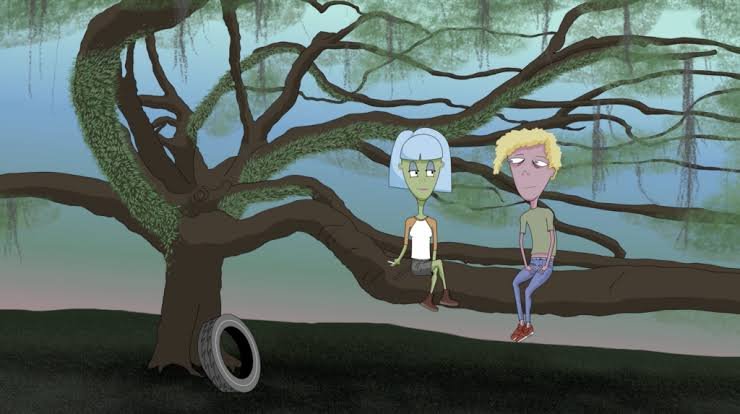
Fig. 1 - Très Mall.
Animated documentary has been important to me because animation can show things that can't be photographed: memories, political systems, historical events, psychological states, and abstract ideas. At the same time, Très Mall draws from political satire, television, sketch comedy, and absurdist animation (Fig. 1). I want the research to be serious even when the images are strange or ridiculous.
As the series has developed, the subjects have gotten more political. I've moved from conversations about philosophy and culture toward conversations with legal and constitutional scholars about the Constitution, the Electoral College, the Senate, executive power, American imperialism, race, capitalism, and the relationship between political institutions and popular culture.
This also led to my research project Made in Mexico, which looked at anti-Communist animated films produced in Mexico during the 1950s with support from the United States Information Agency. I traveled to archives in Washington, D.C., Oaxaca, and Mexico City and found eleven of the twelve films. The research eventually became an article in the Journal of Latin American Cultural Studies (see Larson, Davies & Mendoza 2025).
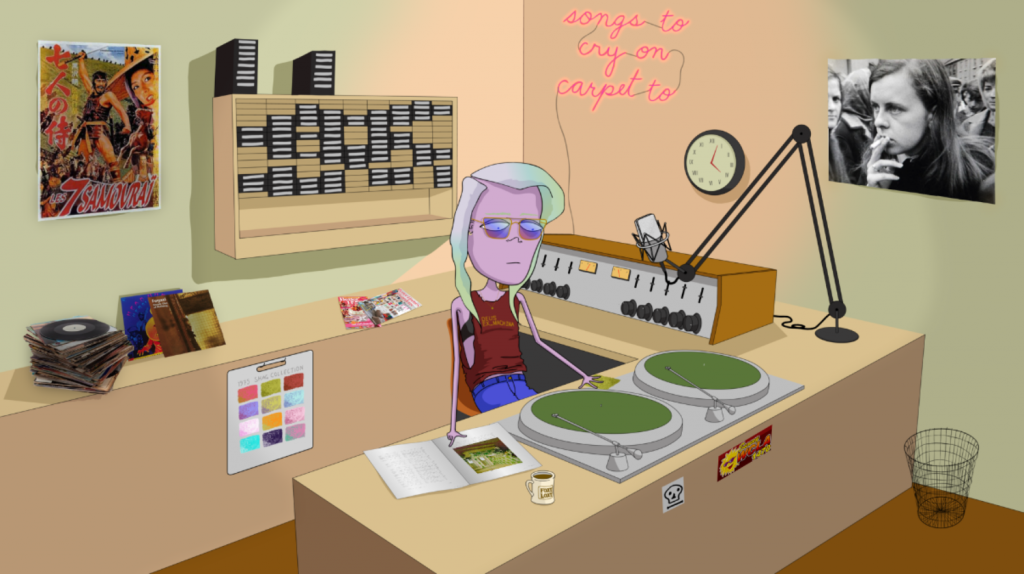
Fig. 2 - Très Mall.
More importantly, it changed how I think about animation. Animation has not just been entertainment. It has also been propaganda, education, advertising, political persuasion, and cultural diplomacy. The medium has its own political history. The latest episode, “Corporate Chains,” features political scientist Darrell M. West and writer Osita Nwanevu as animated guides, as the episode examines the perils of the Electoral College as an outdated system that distorts democracy, amplifies minority rule, and privileges geography over the popular vote. An original score by Jim O'Rourke and Jorma Whittaker supports the episode’s central idea that in a corporatized republic, representation has become a branded commodity.
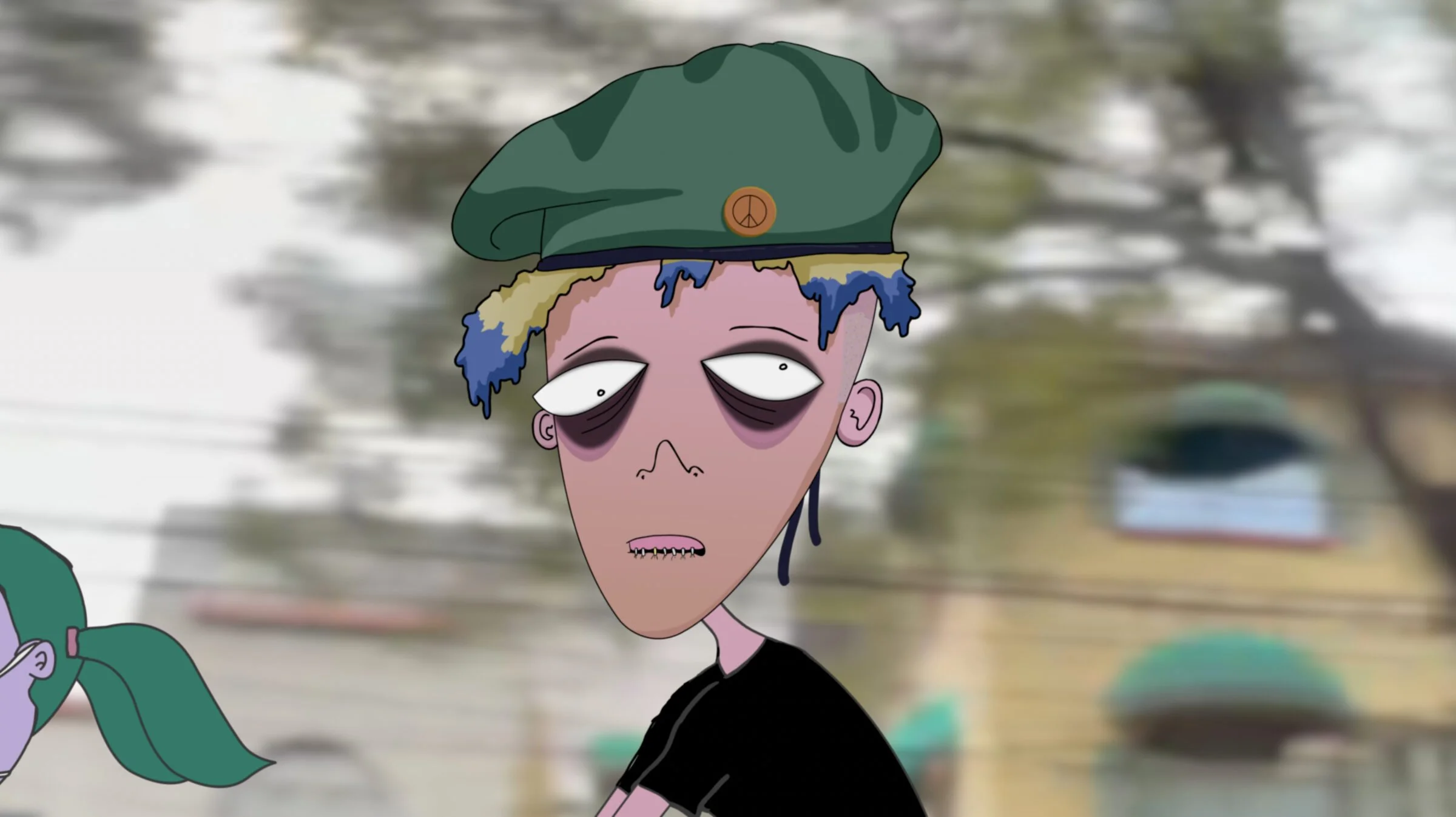
Fig. 3 - Très Mall.
Très Mall now sits somewhere between animated documentary, political satire, contemporary art, and an evolving archive (Figs. 2-3). There are eight completed episodes and more than three hours of material. The mall always remains empty. It contains advertising, politics, history, entertainment, commerce, and memory. The storefronts are arguments. The advertisements are arguments. The empty corridors are arguments. And the conversations are arguments.
The full Très Mall series is available on DIS.
**Article published: November 6, 2026**
References
Larson, Derek G., Byron Davies, and Carlos Oliva Mendoza (2025). “Made in Mexico: The Anti-Communist Cartoons of Dibujos Animados S.A.” Journal of Latin American Cultural Studies 34, no. 2: 275-293.
Biography
Derek G. Larson, graduate of the Yale University School of Art, is an artist and animator at Fairleigh Dickinson University with previous experience at PBS television. He produces the animated documentary series Très Mall with researchers on philosophy, the environment, and the Anthropocene. Recent guests include Noam Chomsky, Michael Hardt, Graham Harman, and Priyamvada Gopal. The series has been screened at Kunsthal Charlottenborg in Copenhagen, Tranen, Times Square in New York, MoCA Atlanta, and the Yale School of Architecture.