To the End of the World: The Haunted Architecture of Desire & The Triangulation of Longing - Part 2
As discussed in Part 1, Shiori’s locket in the Japanese anime series Revolutionary Girl Utena (Kunihiko Ikuhara, 1997) begins as a sealed object that preserves an image and holds desire in place. Once opened, it is no longer an object or vessel made to sustain the appearance of stillness and the stable fantasy that it contains. In this second blog post, I will place the “Black Rose Saga” in dialogue with Krzysztof Kieślowski’s Three Colors: Blue (1993), drawing on the work of Slavoj Žižek to think through fetish, fantasy, and the strange space “between two deaths.”
In Žižek’s analysis of Blue, the protagonist Julie’s relationship with music oscillates between symptom and fetish. After the sudden death of her husband and child, Julie attempts to erase her past by withdrawing from composing and attempts to cut all ties with her husband’s (and her) unfinished work. However, the musical fragments from her past continue to intrude into her present, disrupting scenes as visualised in the sudden intrusion of the blueness, disorienting her emotionally. Žižek sees these intrusions as symptoms—returns of the repressed trauma that Julie tries to suppress. The music erupts into her world as a reminder of the pain she has not processed. At the same time, the music also acts as a fetish for her, like a photograph that functions as a placeholder for the deceased in the continuation of the music, “a dead person magically continues to live” (Žižek 2001: 166).
Žižek explains that a fetish enables the subject to accept a traumatic reality while still emotionally disavowing it rationally. Julie’s final decision to complete her husband’s unfinished composition signals her re-entry into symbolic life and her readiness to begin mourning. I am particularly drawn to Žižek’s reading of Blue and Kieślowski’s anchoring of Julie’s grief in the form of the unfinished musical composition, which occupies a paradoxical position between material and immaterial presence. Kieślowski actively tried to render music tactile and tangible in the film; the tracking shots of Julie’s figure glided across the music sheets, with music conjured non-diegetically, as a form of free indirect discourse (Fig. 1).
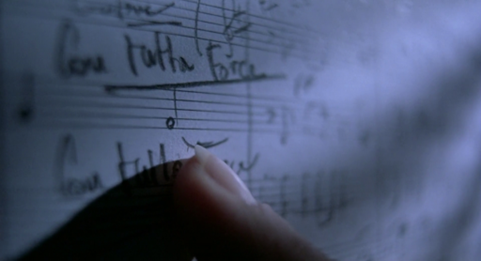
Fig. 3 - Julie touches the music score, conjuring it to play in Krzysztof Kieślowski’s Three Colors: Blue (1993).
One moment in particular makes this tension violently explicit when Julie attempts to free herself from the past by violently destroying the score. She dumps the score in a waste shredder. As the sheets are crushed, the music becomes disfigured and distorted, turning into noise, as if the music itself has some form of material resistance, transforming grief into something that materially resists erasure. Žižek characterises this recurrence of music both materially and immaterially as shifting between the symptom and the fetish (Žižek 2001: 167). They are rendered formally through the interplay of corporeality. The music is heard, handled, destroyed, and distorted. It exists simultaneously as scores and sound, achieving an omnipresence in the spatial-temporal registry of the film. Kieślowski’s ambiguous treatment of music in Blue can be seen as isomorphic with the strange materiality of cel animation. Ontologically, limited animation constructed on layers of celluloid occupies a similar threshold position, neither entirely photographic nor entirely representational. Its frames are drawn by hand but are made visible only through the mechanical inscription of the camera. Like the music in Blue, cel animation resists simple classification. It comprises tactile surfaces and spectral projections, a hybrid medium that hovers between indexical trace and symbolic representation.
In both cases, we encounter a dynamic exchange between presence and absence, between what is materially handled (fetish) and what is affectively experienced (symptom). The shift from fetish to symptom involves not just a change in psychic structure but a transformation in the object’s ontological being. What was once a container of meaning became unstable, leaking with affect. In Blue, this transformation occurs through the collapse of musical form. In Utena, it happens through the friction between visual layers, in the realisation of the stark impossibility of the locket crying as an “outburst of fictional tears”, gesturing towards a breakdown of symbolic containment, and the fright of real tears.
The two triangulated relationships discussed earlier reveal the mechanisms by which Utena stages the displacement and repression of desire. These relations ultimately foil the series’ central triangulation: Utena, Anthy, and Akio. Žižek’s concept of being “between two deaths,” as elaborated in The Fright of Real Tears, resonates here also (Žižek 2001: 169). Just as Julie in Blue exists in a liminal state where mourning cannot begin, but the protective fantasy has collapsed. Anthy also inhabits a suspended in-between condition. Her sacrifice to preserve her brother (Dios, who later became the Akio Ohtori we know as the acting headmaster of the academy) from symbolic death marks the erasure of her own subjectivity, becoming the Rose Bride, a vessel of repetition, blame, and fantasy. We see in Anthy a similar level of disgust and a visceral aversion to life, to which Žižek identifies in Julie in the aftermath of loss. In response to the grotesque repetition of roles she is forced to perform. Anthy moves with a sense of inertia, speaks in a monotone, and rarely initiates action outside the script of her assigned function. Her passivity and hollowness are also tinged with a tone of sarcasm, like the time when she jokes about poisoning Utena (Episode 9).
By offering herself to the mob in Dios’s place (Episode 34, conveniently titled “The Rose Seal”), Anthy undergoes a symbolic death that precedes her physical death (Fig. 2). Therefore, Anthy’s rose garden is not a celebration of life, blooming with life’s vitality, but a refusal of decay. With the physical death of her brother, she became caught in a structure that forecloses mourning. She began to house the Sword of Dios, and her body was transformed into a site of utilitarian exploitation. Bound to the ideal of eternity, she becomes affectively static and emotionally opaque. In The Fright of Real Tears, Žižek formulated, after Lacan’s reading of Antigone, as “the dimension of ate, of the horrifying space between two deaths” (Žižek 2001: 169). This space is inhabited by Anthy, whose sacrificial gesture to prevent her brother from his second death, “to give him a proper funeral that will secure his eternalisation”. This resulted in the obliteration of her own subjecthood; she is without her desire, but the insistent demand of being the Rose Bride.
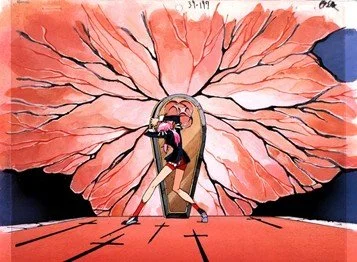
Fig. 2 - Anthy, trapped in a coffin of her own making.
In this process, Anthy ceases to exist as a social subject; she becomes the ostracised witch, the Rose Bride, and the cursed vessel through which power is redistributed. She is neither alive nor dead, in a state of symbolic stasis, a being whose function is ritualistic repetition. Whereas Anthy consciously relinquishes her subjecthood to preserve another, Mikage compulsively clings to a fantasy that denies loss. His refusal to mourn traps him in a closed circuit of repetition, one that eventually collapses under the weight of its frightening truth. Unlike Mikage, who wants to resurrect Mimiya from his symbolic death by installing him as the Rose Bride, Utena recognises the structural impossibility of rescuing Anthy, as she had already sacrificed herself in symbolic terms.
Utena’s and Anthy’s final decision to leave the Ohtori Academy, although it clearly exists on a lesbian continuum, does not mark a romantic closure. It is a denial of the duelling system, of the father’s language, of the myth of salvation, in good faith, of finding an alternative world. For this reason, the “reconstitution of the fantasy frame” never took place (Žižek 2001: 175). What remains is not a new order; as the academy dissolves around them, so does the symbolic scaffolding that defined them in the past. Utena ends not with fulfilment; for this reason, the adolescent moratorium is not a passage to adult normativity, but a space haunted by failed rites and broken myths. In this final departure, we are reminded of what Halberstam calls “the concept of practising failure” as “to be underachievers, to fall short, to get distracted, to take a detour, to find a limit, to lose our way, to forget, to avoid mastery” (Halberstam 2011: 121).
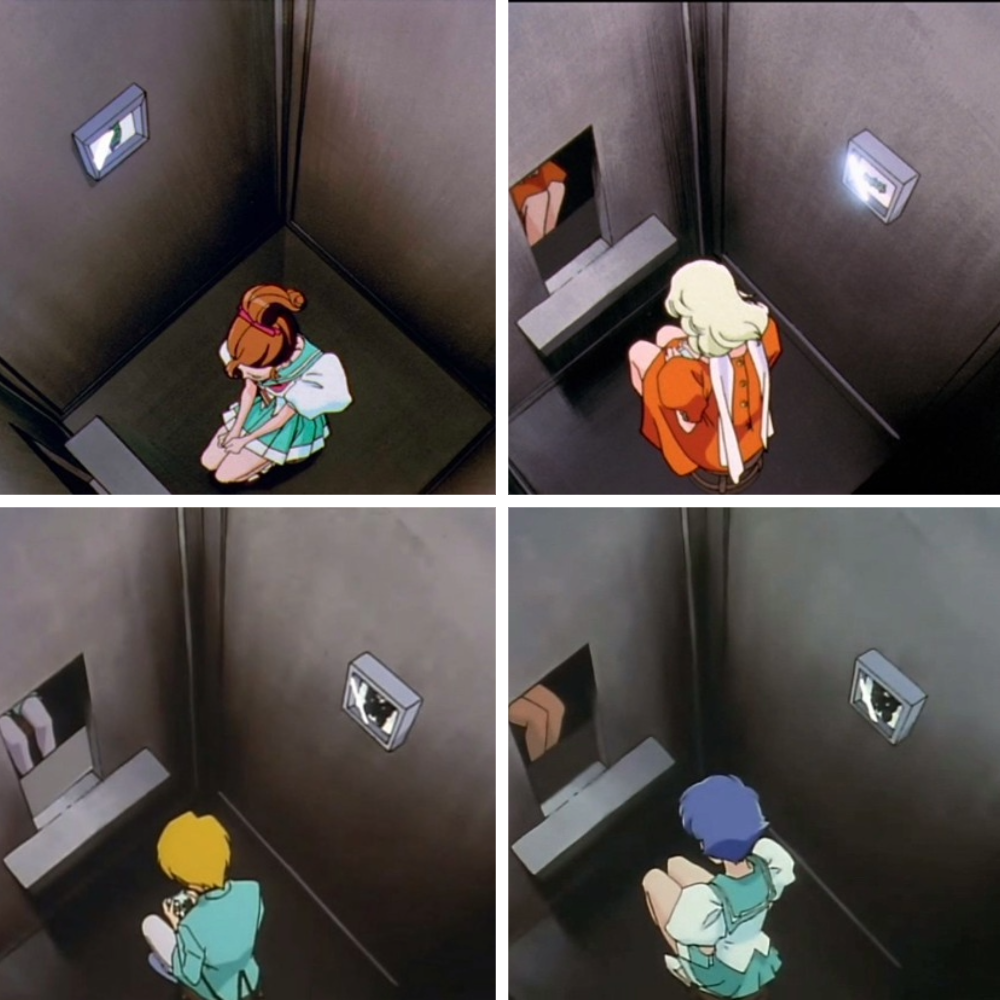
Fig. 3 - Formal Repetitions of the Elevator scenes.
In the series, the “Black Rose Saga” is designed as the one-way corridor leading toward the climax of the “Apocalypse Saga.” Yet this movement is not truly linear; rather, when viewed, the formal repetition of the cels and the composition with each passing duel scenes felt almost endless in its cyclicality (Fig. 3). However, the sliding motion of the celluloid layers, first descending and then rising again, powers the elevator that sinks into a space shaped by denial and grief, gaining momentum as fantasies begin to crack. I hope that, over the course of these two blogs, I have shown that the “celluloid body,” like the photographic or musical object, mediates and displaces non-normative desires through the multidirectional flow of libidinal energy that departs or leaks from the stabilising logic of the Symbolic Order.
**Article published: April 10, 2026**
References
Halberstam, Jack. 2011. The Queer Art of Failure. Durham: Duke University Press.
Žižek, Slavoj. 2001. The Fright of Real Tears: Krzysztof Kieślowski between Theory and Post-Theory. London: BFI Publishing.
Biography
Youxi Chen recently completed her MPhil in Film and Screen Studies at the University of Cambridge. As a seasoned ACG enthusiast, her interests meander between serious critical inquiries and obsessive Doujin.