
To the End of the World: The Haunted Architecture of Desire & The Triangulation of Longing - Part 1
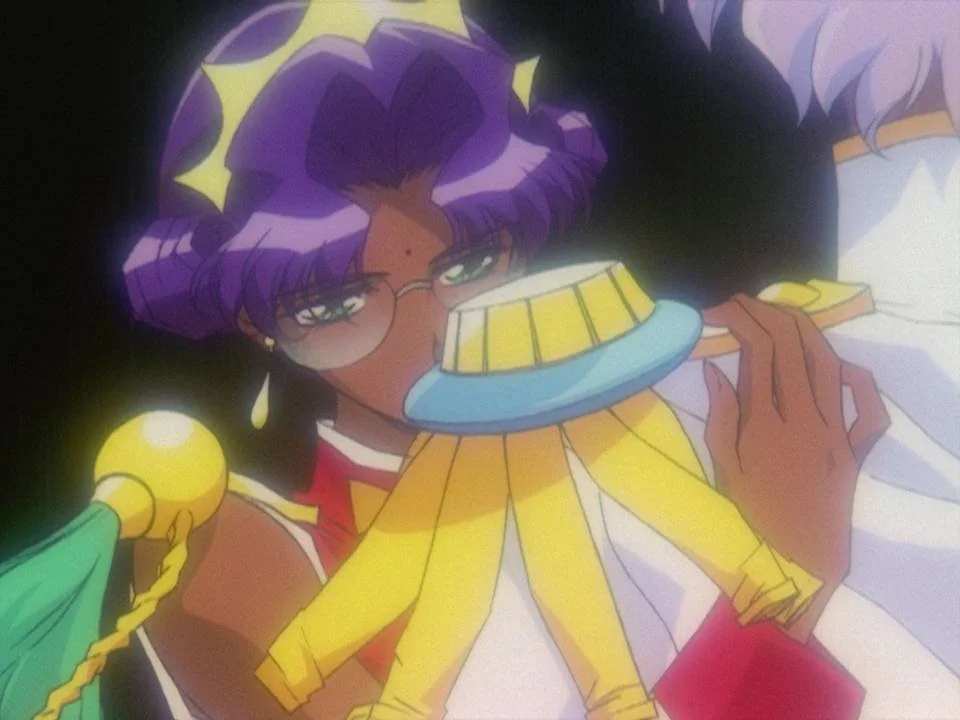
Fig. 1 - Himemiya Anthy.
Revolutionary Girl Utena, the Japanese anime television series that first aired in 1997, follows Tenjō Utena, a tomboyish girl who dreams of becoming a prince and knight in shining armour. Upon entering the fantastical and highly hierarchical Ohtori Academy, Utena soon entangles herself in the ritualised duels of the Student Council, fighting for the mysterious Rose Bride, Himemiya Anthy, a figure objectified by those who compete for her hand (Fig. 1). The series has a particular cyclical structure, with each episode lasting less than 30 minutes and structured into three narrative sections—episodes 1 to 13 form the “Student Council Saga”, episodes 14 to 23 comprise the “Black Rose Saga”, and episodes 24 to 39 conclude with the “Apocalypse Saga”. The structural arrangements highlight the series’ heightened theatricality, resulting in a tightly choreographed work with a recursive and self-reflexive mode of storytelling. As the series unfolds, Utena’s story spirals into a vibrant phantasmagoria with variations on themes of adolescence, trauma, desire, and revolution.
Revolutionary Girl Utena - Trailer
The edit of Every Elevator Sequence.
In this first of two blogs, I will turn to a series of close readings of the mediation of desire within the “Black Rose Saga”, which comprises some of the most experimental episodes of the serial. Through the analysis of recurring visual motifs, Part 1 illuminates how desire is mediated through mechanisms of repetition and formal structures. During the “Black Rose Saga” episodes, an elevator therapy session is held prior to each duel, in which Mikage Sōji serves as the therapist, guiding each duellist to draw out their repressed desires that motivate their indignation. By physically descending into the subterranean layers of the Nemuro Memorial Hall, these sessions lay bare the psychic deadlocks that fueled the serial’s repetitive momentum.
My readings will take a psychoanalytic approach, tracing how the director Ikuhara Kunihiko has choreographed the poetics of longing, trauma, and erotic transformation of the self. The triangular relationship between Mikage, Mamiya, and Tokiko is the foundation/prototype of all the disavowed traumas that structure the “Black Rose Saga” (Episodes 14-23). Mikage, who was once a brilliant researcher at Ohtori Academy, is drawn into entanglement with Tokiko and her terminally ill younger brother, Mamiya. What begins as a scientific project dedicated to prolonging his life becomes a melancholic fixation. Mikage has come to associate Mamiya with purity and forever suspended time. For this reason, he hopes to start a revolution that replaces Anthy with Mamiya as the Rose Bride, a symbol of eternity. Following Mamiya’s death, Mikage represses this event and constructs a false memory in which the boy remains alive, mirrored in the mirage image of the Nemuro Memorial Hall, an illusion later revealed to be a construction of Akio’s manipulation (Fig. 2).
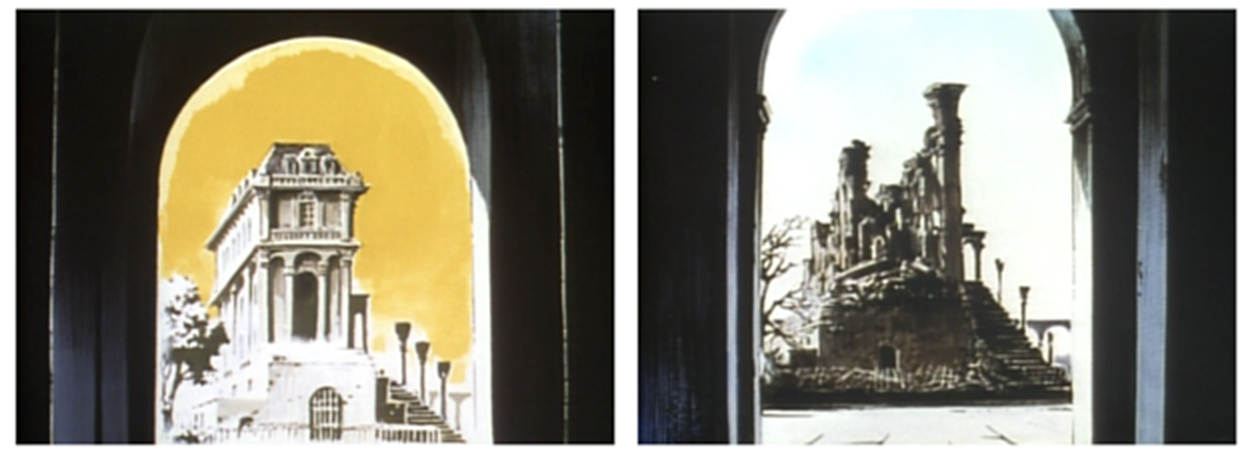
Fig. 2 - The mirage and ruination of the Nemuro Memorial Hall.
During the saga's final episode, Tokiko reappears as an adult; her presence marks the passage of chronological time outside the confines of the Academy, becoming a disruptive force that destabilises Mikage’s suspended temporality. Their relationship is triangulated through an affective structure in which Mamiya serves as the object petit a, which is the object of the lack or the object cause of desire. As a phantasmatic anchor, he never appears as himself, for Anthy has usurped his image for the entire duration of the “Black Rose Saga”. Mikage’s psychic reality orbits around Mamiya’s absence, in a loop of deferred mourning in denial of his death. As the object petit a, it is a lost piece that comes to represent the subject’s own division; he is less of an autonomous character than scopic illusion, a screen (cemented in the form of a photographic portrait) to which Mikage project his desires to freeze time, avoid loss, and sustain the moratorium fantasy of the celluloid world.
This triangular formula reaches its most disorienting visual form in the final episode of the “Black Rose Saga”, where photographic portraits of real people intrude upon the animated diegesis. For Mikage, the carefully narrated fantasy of saving Mamiya crumbled into the wasteland upon being confronted with the repressed memory of Mamiya's death, irretrievable loss, and guilt. The abrupt puncturing of photographs into the animated diegesis mirrors the traumatic nature of this psychic unravelling. Photography here is not merely an index of the “real world,” but a manifestation of the Real, as a violent eruption where the Symbolic Order breaks down, and the subject is confronted with something irreducible, beyond narrative coherence or visual containment.
For Mikage, photographs (or representations of photography) function both as a fetishistic object and a symptom. As fetish, the photographic allows him to look away from the reality of Mamiya’s death by indulging in the illusion of his presence, to which Slavoj Žižek observes:
“a fetish can play a very constructive role in allowing us to cope with a harsh reality… they are thorough ‘realists,’ able to accept the way things are, since they have their fetish to which they can cling in order to cancel the full impact of reality.” (2001: 166)
On the other hand, the photo of Mamiya also expresses Mikage’s symptom of loss and grief; the image, due to its ontological instability, is both a persistent trace of the trauma and an active attempt to repress it. As a symptom, it is an energy, with Žižek again, “disturbs the surface of false appearance, the point at which the repressed ‘other scene’ erupts” (Žižek 2001: 166).
This duality, embodied by the photograph, has resulted in a transformative power that fuelled Mikage’s duel against Utena. It became an extremely volatile and destructive force, set in motion by the oscillation between repression and disavowal. Similarly, in the love triangle between student council member Arisugawa Juri, her former friend and secret love interest Shiori Takatsuki (Episodes 17, 28, 29), and the returning fencing captain Tsuchiya Ruka, the small gold locket that Juri wears becomes a central fetishistic object mediating the triangulation of their desires. During Mikage’s counselling session with Shiori, we witness a transformation in the function of Juri’s locket, shifting from a fetishistic object to a symptom. Initially, the locket containing Shiori’s photograph serves as a fetish (Fig. 3). It is kept tightly shut as a feature of refusal, worn close to Juri’s body, and never to be opened. As such, it functions to preserve the objectification of a static, idealised Shiori, allowing Juri to retreat from the pain of ever professing her impossible love for her.
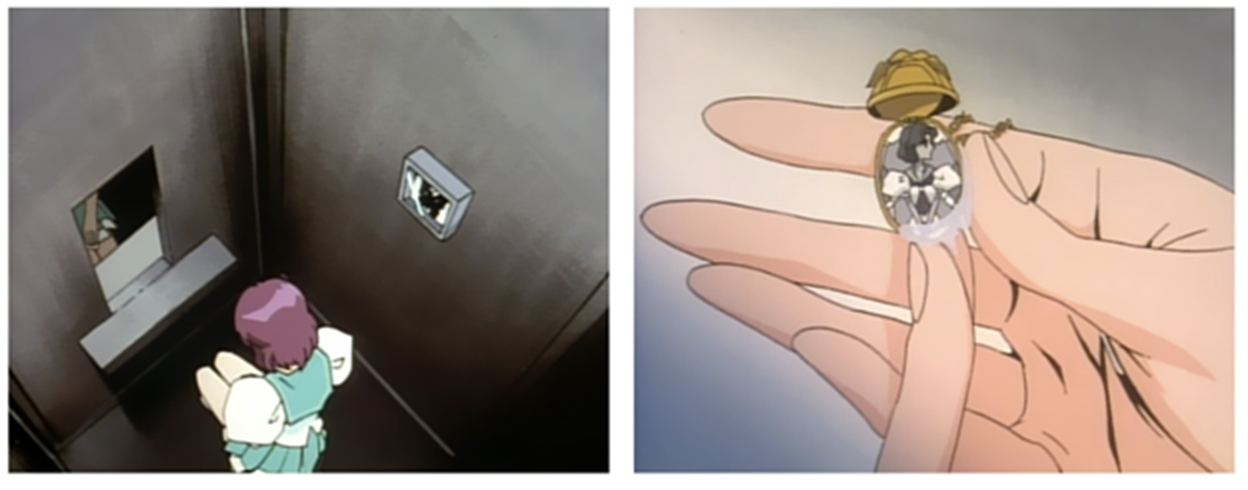
Fig. 3 - Juri's locket containing a cropped-out photo of Shiori.
However, when Mikage pressures Shiori to “go deeper and deeper” into her repressed feelings, the locket bursts open—this time not by Juri, but by Shiori herself. The moment the locket becomes unlocked, tears flood out in the form of an affective rupture. Were they Juri’s tears or those of Shiori herself? From then on, the locket is no longer a sealed container of a fantasy, forever shielding and repressing. It has become a site of overflow, as the return of the repressed. The tears mark a breakdown in the structure of disavowal. What was once a stabilising fetish is now revealed as a symptom—an object that no longer conceals desire but exposes its unresolved and painful core. The image of Shiori, once frozen into the photographic, becomes unbearably animated, as if the photograph itself has begun to cry. In Part 2 of this blog, I will continue discussing the implications of this now-animated tear. As we will see in Part 2 next week, there is an energy to be gained from the oscillating and destabilising process.
**Article published: April 3, 2026**
References
Žižek, Slavoj. 2001. The Fright of Real Tears: Krzysztof Kieślowski between Theory and Post-Theory. London: BFI Publishing.
Biography
Youxi Chen recently completed her MPhil in Film and Screen Studies at the University of Cambridge. As a seasoned ACG enthusiast, her interests meander between serious critical inquiries and obsessive Doujin.