How Arcane (Riot Games/Fortiche Production, 2021–) Visualizes Class Conflict Through Its Fantasy World
When Arcane (Riot Games/Fortiche Production, 2021–) first came out, most people focused on how beautiful it looked. And that makes sense. The painterly animation is striking right away. But what really makes the series stand out is something deeper. It shows class conflict in a way that feels almost physical. Not just through the story, but through the world itself. In Arcane, inequality is not explained to you. You see it instantly.

Fig. 1 - Arcane (Riot Games / Fortiche Production, 2021–). https://wallpapercave.com/arcane-poster-wallpapers.
Set in the universe of League of Legends, the series follows the tension between the wealthy city of Piltover and the undercity of Zaun. This divide shapes everything in the narrative. The conflict between these two spaces is central to the story and its characters. But what matters more is how the show makes this divide visible without relying on long explanations.
One of the clearest ways it does this is through space. Piltover sits above - it is bright, open, and carefully structured. Zaun exists below. Dense, polluted, and hard to navigate. This vertical arrangement is simple but effective, and the higher you are, the more control you have. The lower you go, the more unstable life becomes. Deko Saputro’s Marxist analysis of Arcane highlights how this mirrors real-world systems where power and resources are unevenly distributed. The show turns that idea into something you can actually see.
The visual style of the series strengthens this contrast even more. Piltover feels calm. The colours are warm. The architecture is elegant and balanced. Everything looks intentional. Zaun feels completely different. The colours are harsher. Greens and purples dominate. Lights flicker. Surfaces look worn and layered. Nothing feels stable. You understand the difference immediately. The world itself explains who has power and who does not.
Characters also carry this contrast in how they look and move (Figs. 1-2). Jayce represents Piltover. His design is clean. His movements are controlled. He fits into his environment. Vi and Jinx feel different from the moment they appear. Their designs are rougher. Their movements are faster and less predictable. They react to the world rather than control it. This difference is not just about personality. It reflects where they come from. As noted in a review by VNHS Mirror, the show consistently presents these opposing perspectives and lets the audience feel both sides of the divide.
The fantasy elements of the series make this even clearer. In Piltover, Hextech represents progress. It is controlled, polished, and widely accepted. It looks safe. In Zaun, Shimmer offers power too, but in a very different way. It is unstable. It affects the body directly. It comes with visible consequences. Both technologies give people strength, but only one is seen as legitimate. This difference reflects a familiar pattern. Access to “good” forms of progress often depends on where you start.
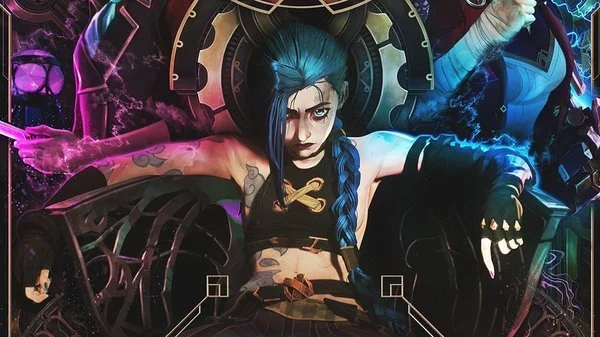
Fig. 2 - Arcane.
The show also uses specific scenes to bring all these ideas together. The bridge sequence early in the series is one of the clearest examples. Piltover enforcers stand against Zaun citizens. The space between them feels heavy. The composition is simple, but it creates tension. Lighting plays a role too. One side is more visible. The other is partially hidden. Without much dialogue, the scene shows who holds power and who does not.
Another strong example appears later in the series, during the confrontation between Vi and Jinx. The setting feels unstable, almost fragmented. Colours shift quickly. The environment reflects Jinx’s mental state, but it also connects back to Zaun as a whole. Chaos is not just emotional here. It is environmental. The world and the character mirror each other. This is where animation becomes especially powerful. It can blend internal and external conflict in a single image.
What makes Arcane so effective is how it uses fantasy to make real ideas clearer. The setting is fictional, but the structure feels familiar. Divided cities, unequal access to resources, and different rules for different groups are all things we recognise. Fantasy gives the show space to exaggerate these ideas, but also to organise them visually. It becomes easier to understand inequality when you can see it built into the world.
At the same time, the way audiences interact with shows like Arcane today adds another layer. Watching is no longer a one-step experience. People analyse scenes, rewatch moments, and look for deeper meaning. They also explore related content online. Depending on where they live, access to that content can vary. Some viewers even use tools like a watch Youtube TV with VPN guide to reach videos, breakdowns, or discussions that are not available in their region. This shows how global the conversation around a series like Arcane has become.
Animation plays a key role in making all of this work. As Paul Wells explains in Understanding Animation, the medium has a unique ability to present abstract ideas in a visual form (Wells 1998). Arcane uses this strength fully. It does not just tell us that inequality exists. It builds a system where every visual detail supports that idea. Space, colour, movement, and design all work together.
In the end, Arcane shows how fantasy animation can go beyond storytelling. It can build worlds that reflect real systems in a clear and engaging way. The conflict between Piltover and Zaun is not hidden in dialogue. It is present in every frame. That is what makes the series so memorable. You do not just follow the story. You experience the divide. And once you notice it, it stays with you.
**Article published: March 27, 2026**
Biography
Linda Carpenter is an accomplished writer and content strategist with a passion for crafting stories that inspire and engage readers. She specializes in creating compelling narratives for digital platforms, blending creativity with insight to connect brands and audiences. When she’s not writing, Linda enjoys exploring new cultures, sipping artisanal coffee, and collecting vintage books.