Review: Rogue Trooper (Duncan Jones, 2026)
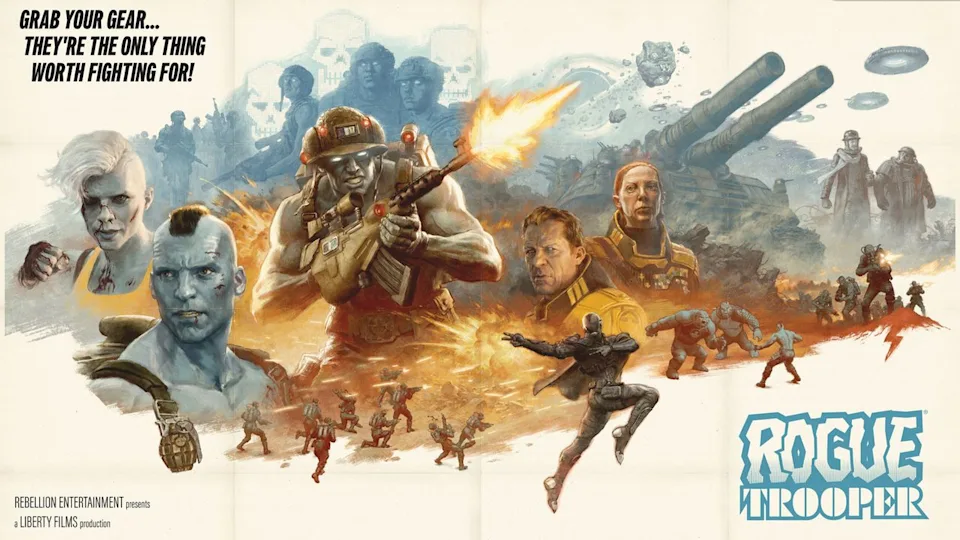
Fig. 1 - A poster Jones commissioned for the film from artist Paolo Rivera, showcasing its sprawling cast of ugly weirdoes.
Following almost a decade’s wait for the next Duncan Jones’ project and even longer for a new 2000AD adaptation, the stakes are high for Rogue Trooper (2026) even before the fighting starts. Like its heroes, however, it overcomes the odds, blasting onto the screen with cool confidence, daffy humour and biting anger (Fig 1). This will be familiar to fans of the source material, which is where the success of this adaptation lies: proudly, loudly, Rogue Trooper is a comic book film. It fades up on the same comics panels that opened the character’s debut strip in 1981; Dave Gibbons’ art guides us down onto the surface of Nu Earth, which Gerry Finley-Day’s caption boxes inform us is “just another battle-ground in a galaxy wide war” (2007, 4). That war is fought by Genetic Infantrymen, blue-skinned soldiers with numbers instead of names and personalities saved onto biochips which can be stored on battlefield equipment when they die until their new bodies can be grown. GI 19 (Aneurin Barnard) quickly becomes custodian of his three squadmates after they are killed in action: Helm (Daryl McCormack) sitting in his helmet, Gunnar (Jack Lowden) inhabiting his gun, and Bagman (Reece Shearsmith) controlling his backpack. Together, they set off across Nu Earth to contact their base, get their bodies back and prevent a looming massacre orchestrated by a traitor in command…
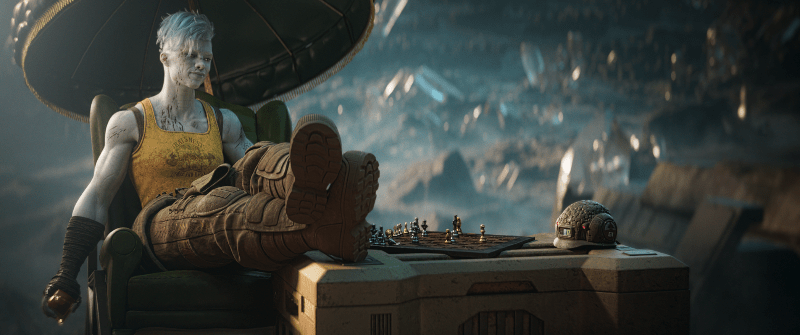
Fig. 2 - Venus Bluegenes and Helm enjoy a romantic game of chess. They have wonderful chemistry despite his being a hat.
This is all very comic book-y and only gets more so; see Peter Serafinowicz’s musical French sniper and Hayley Atwell’s 9-foot badass Venus Bluegenes (Fig 2). Another medium also looms large over the production, but despite parallels between running and gunning onscreen and on consoles (the strip was itself adapted into a third person shooter in 2006), Rogue Trooper is not a video game film. Such associations largely come from the tools used in production. Animators worked within an indie budget by starting on Unreal Engine before supplementing the results by hand (Horst 2026). While the hybrid approach may prove off-putting at first, the storytelling and style on show are compelling enough that it soon becomes a non-issue. Environments are particularly engrossing and visually rich, beautiful despite desolate terrain and ever-present smog. Everything is scaled up to overwhelming extremes—the opening sequence is a raid on an enemy fortress that also happens to be a tank. 19 and his brothers’ position as a four-in-one-man army is repeatedly emphasised by the war machines looming over them.
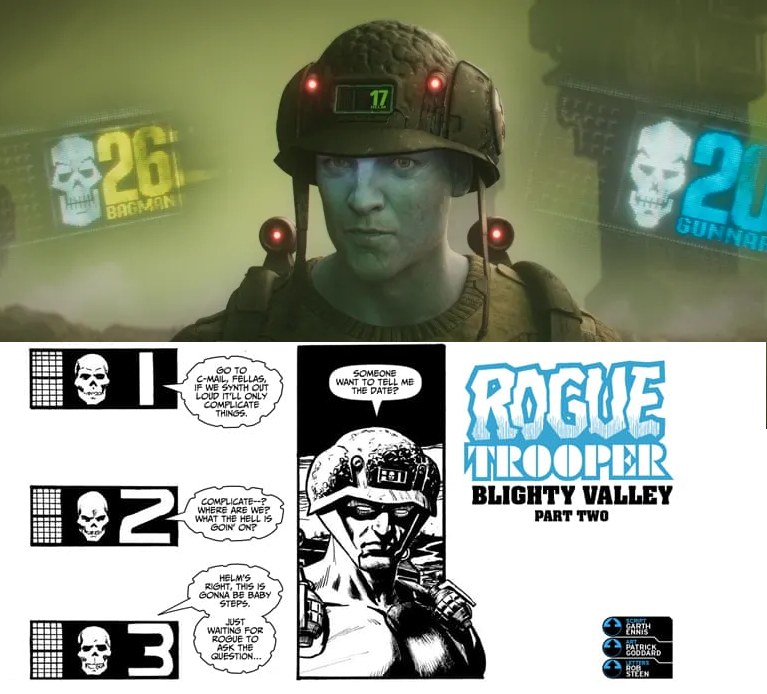
Fig. 3 - An example of the hovering chips from the film, alongside panels from Garth Ennis and Patrick Goddard’s brilliant ‘Blighty Valley’ storyline; variations between the skulls in both emphasise their distinct personalities.
While its storytelling is comic book to the core, the film does not foreground its source medium visually as often as other animations following the example of Spider-Man: Into the Spider-Verse (Bob Persichetti, Peter Ramsey & Rodney Rothman, 2018) and its sequel, such as TMNT: Mutant Mayhem (Jeff Rowe, 2023) and Asterix and Obelix: The Big Fight (Alain Chabat & Fabrice Joubert, 2025). Drew Morton’s term “stylistic remediation” refers to how adaptations borrow stylistically from their source material, incorporating other mediums’ affordances to bridge the gap between page and screen (2016, 7). Rogue Trooper’s budget means its remediation is less pronounced, but the film is faithful to the original designs of Gibbons, Will Simpson (whose strip ‘The War Machine’ influenced its colour palette; Wise 2026) and other art-droids who worked on the character over the decades, some of whom contributed to the production (Horst 2026). There are also the floating Biochips that hover alongside 19 when his fallen comrades communicate. First seen in Finley-Day and Brett Ewin’s “Bagman Blues Part 2” in 1982, the opening page of which is directly adapted by Jones (2007, 151), this visual has been used by several artists since to clearly distinguish which chip is saying what (Fig 3).
The squad’s personalities and their relationships are the heart of Rogue Trooper’s story. 19’s squad are not tools to save the day or bland comic relief, but clearly drawn characters with aspirations, arcs, even accents. In a nod to working-class British squaddies of history and pop-culture, Bagman is relocated to the North of England, Helm to Northern Ireland and Gunnar to Scotland. Jones’ screenplay takes full advantage of their regional identities, omitting received pronunciation from the cast almost entirely save for establishment figures who profit from the soldier’s suffering. Tellingly, the human cast are uncannier than the GIs, with grotesque and exaggerated features. If our heroes are only ‘mostly human’, as Bear McCreary’s magnificent marching song has it, that can only be a good thing.
The characterisation of Rogue is largely consistent with the comics too; Barnard’s 19 is less gruff than his on-page counterpart, but more Welsh (a change this Cardiffian reviewer loves, although the film’s subtitles struggle to spell ‘cwtch’). Stoic but empathetic, he cannot help but get involved in whatever macabre scenario he stumbles across. This ties into Gibbons’ original conception of the character (Bishop and Stock 2017, 83) and the structure of serialised comic strips, which is where the film leans heaviest on its source material. The squad’s journey starts as a series of set pieces in which they encounter new characters, hazards or hardware and are forced to adapt and overcome, just as they would each week on the page. This episodic stretch might have worn thin if it had not dovetailed beautifully in the finale, which brings all the (surviving) elements from prior adventures crashing together with gusto.
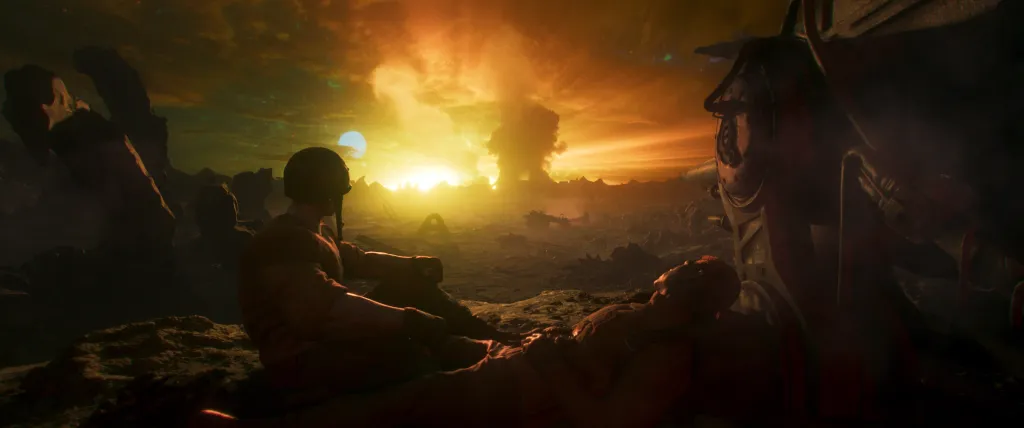
Fig. 4 - Rogue and Helm share a rare moment of quiet looking out at the ruined but beautiful Nu Earth landscape.
Most excitingly, these connections to the original strip are not only integrated but interrogated: Is 19 stopping to help fellow soldiers putting his squadmates in jeopardy? When fighting a pointless war, what does it mean to be of service? This being 2000AD, answers do not come easily. The comic’s most famous hero is also a tyrannous fascist: Judge Dredd (Molcher 2023). We cheer when he brings down the perp of the week, but the system he enforces remains. Similarly, how can one man, his helmet, gun and backpack make a difference in a war where both sides are as cruel and petty as the other? (Fig 4). The film’s case can best be seen in the changed emphasis of his primary objective: in the comics, Rogue is hunting for the traitor general who betrayed his GI brothers. Onscreen, 19 is trying to get word home to prevent another massacre. 2000AD has always walked the line between political and pulp (Stock 2023, 65-85), and entertainment likewise takes the lead here. While some harrowing scenes and pitch-black humour make the film’s anti-war stance clear, it is first-and-foremost a bunker-busting blockbuster, having its satirical cake and blowing it up too.
These disparate elements, the serious and unserious, spectacular and silly, ensure Rogue Trooper is not only a loud and proud comic book film but the most 2000AD film ever made. It revels in gags, action and needle drops, but the grotesqueness, ridiculousness and murkiness of its origins are ever present, reframing the familiar in spiky, punky ways. It gleefully borrows from other strips across the prog’s history: the home-nations heroes from Strontium Dog, the grotesque humans from Nemesis, even the pseudo-swear ‘funt’ from Sinister Dexter. Its opening crawl, despite inevitable comparisons to Star Wars, reads more like a ‘Previously on’ recap, ending on a wry note reminiscent of 2000AD’s alien editor Tharg. We need more comic book films that foreground such cultural specificity and weirdness, stretching the term and reminding us comics are not one genre, but a medium, and that medium has everything to offer.
Zarjaz, Earthlets!
**Article published: October 30, 2026**
References
Bishop, David and Karl Stock. 2017. Thrill-Power Overload: 2000AD–The First Forty Years. Oxford: Rebellion.
Ennis, Garth (w), Patrick Goddard (a), and Rob Steen (l). 2024. Rogue Trooper: Blighty Valley. Oxford: Rebellion.
Finley-Day, Gerry (w), Dave Gibbons, Brett Ewins (a) et. al. 2007. Rogue Trooper: The Future of War. Originally printed in 2000AD Progs 228-265. Oxford: Rebellion.
Horst, Carole. 2026. “How Duncan Jones Made ‘Rogue Trooper’ Look Like a Studio Epic on an Indie Budget.” Variety (June 20, 2026), available at: https://variety.com/2026/film/festivals/duncan-jones-rogue-trooper-1236785355/?bcmt=1.
Molcher, Micheal. 2023. I am the Law: How Judge Dredd Predicted Our Future. Oxford: Rebellion.
Morton, Drew. 2016. Panel to the Screen: Style, American Film, and Comic Books During the Blockbuster Era. Jackson: University Press of Mississippi.
Stock, Karl. 2023. Comic Books Punks: How a Generation of Brits Reinvented Pop Culture. Oxford: Rebellion.
Wise, Damon. 2026. “‘Rogue Trooper’ First Look At Teaser Trailer For Duncan Jones’ Hand-Crafted Take On ‘2000 AD’ Comic Book’s Dystopian War Machine; Q&A With Filmmakers.” Deadline (April 20, 2026), available at: https://deadline.com/2026/04/rogue-trooper-first-look-duncan-jones-stuart-fenegan-2000-ad-1236865572/.
Biography
Jonathan Macho (he/him) completed his PhD in Creative and Critical Writing at Cardiff University in 2026. His thesis was centred on a prose novel which behaves like a comic book, bringing both mediums together through a process of stylistic remediation. His academic writing includes a review of Spider-Man: Across the Spider-Verse for the academic blog Fantasy/Animation and the chapter on Doctor Who comics and annuals for the Routledge Handbook of Doctor Who. He also has a substantial number of creative publications to his name, including a short story published by AHOY comics, a comic in Dogbreath fanzine, and several spin-offs from Doctor Who. He was once the proud recipient of Tharg’s ‘Letter of the Week’ in 2000AD.