Reflections: A Piece on Gints Zilbalodis
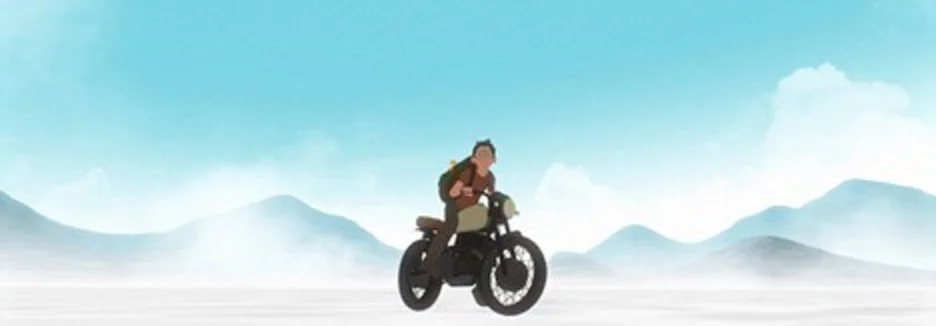
At the 2025 Academy Awards ceremony, the actress Goldie Hawn announced that the winner of the Oscar for Best Animated Film was Flow – a moment where global audience members discovered the film’s creator and director, the Latvian animator Gints Zilbalodis. Yet another previous feature of his awaits such attention. The 2019 film Away, Zilbalodis’ the director’s debut feature, laid the foundation upon which Flow is built. Away follows a nameless boy riding a motorcycle towards the mythical Cloud Harbour as a behemoth shadow evoking Hayao Miyazaki’s No Face (from Spirited Away [2002]) follows him (Fig. 1). Despite being the debut of Zilbalodis, Away remains under-appreciated and has often been forgotten at the expense of the focus on the critically successful Flow. This blog post therefore asks what makes Away noteworthy and worthwhile in modern animation.
To start, what does a wider discussion of Zilbalodis’ Away offer? When mentioned alongside the critical darling Flow within physical disc releases, an air of prestige is presented. To see Away and Flow included amongst filmmakers such as Akira Kurosawa on prestige home video labels may seem odd to some. Yet, being alongside filmmakers such as Kurosawa is apt for the work of Gints Zilbalodis. For instance, a sequence in Away which features the boy riding a motorcycle on the surface of a mirror lake. With the flock of birds reflecting beneath him as they soar above, an oneiric quality emerges. Such dreamlike images seem apt for the small bird riding in the boy’s backpack. After exchanging glances, the bird leaves for the sky. The point of view becomes that of the soaring bird, leaving behind the world beneath. Most of the animals in Away ranging range from elephants, cats, and the birds live within a group. Not the boy. As he rides on echoing the lone biker in Death Stranding, one wonders: is he happy?
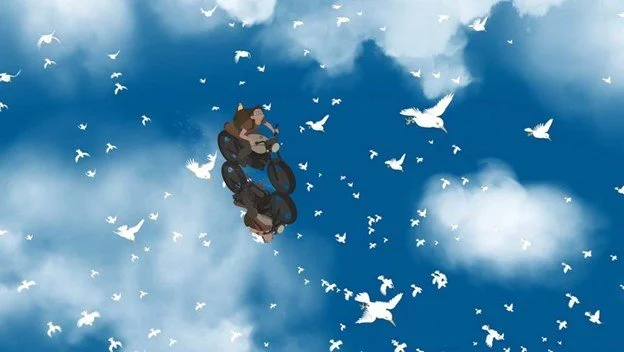
The sequence captures the cosmic terror from one high angle. The angle previously shown with a hawk, this POV shot has now metamorphosed from the horror of demise to that of existence itself. In Away, a plane slowly descending against the glow reminds us that the shadows falling are metaphysical evocations. No dialogue is present in the film, and nothing explicitly states how the boy got to his present place. The imagery evokes a world where nature may be reclaiming itself over humankind.
This theme is prevalent in Gints Zilbalodis’ work since Flow goes one step further by eliminating human perspective entirely. Animals become the subject of the film but like Away, the animals are never anthropomorphized as in films like Fantastic Mr Fox or various Bugs Bunny cartoons. The animals in Zilbalodis’ films don’t have a human perspective on the events unfolding before them, but they capture our emotions through actions and behavior, not words.
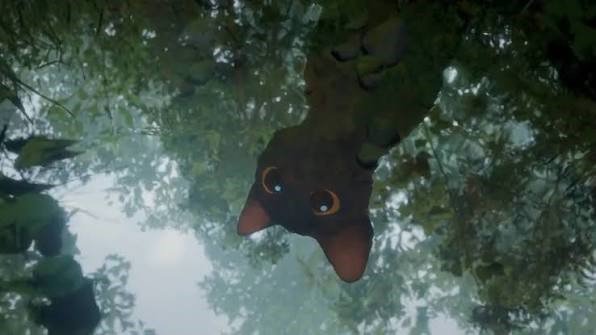
Another element that links Away and Flow is water. The aforementioned sequence with mirror lake is carried over into Flow as the opening shot features the feline protagonist gazing at its reflection in a puddle (Fig. 3). Soon, a flood of biblical proportions forces the cat to flee and seek a way to persist in the world. Survival of the fittest has become the main objective as other animals such as dogs and birds have formed groups to sustain themselves amidst a possible extinction event. Along the way, the cat forms a rag tag team of creatures consisting of a labrador retriever, a capybara, a ring-tailed lemur, and a secretary bird. Riding in a sailboat, the animals explore a world where traces of humanity appear including carved statues of cats, various trinkets, and even an immense city that combines the waterways of Venice and the mythical kingdom of Atlantis.
With this apocalyptic tone, the film evokes a quote from the French critic turned filmmaker Jean Luc Godard. Writing about the work of the Japanese director Kenji Mizoguchi, Godard described the filmmaker in words which also apply to Zilbalodis’ films, namely that of “an adventure which is at the same time a cosmogony” (Godard 1986, 70). The question of existence rings out. The Shadow following the boy seems gentle, but it takes the life of living beings such as a deer along the way. In the beginning of Away, the boy dwells in an oasis, a space where he encounters his feathered companion and is shown beauty in a world devoid of people. While humans are scarce, colossal entities roam through the world with the animals. In Away, the shadow is the precursor for the whale featured in Flow, echoing the book of Job and the great white whale Moby Dick.
Another theme that comes forth in Away, is that of being alone in the cosmos. The boy in Away and the cat in Flow both find ways to survive in a beautiful yet cruel universe through companionship. The way to go forward for Zilbalodis’ protagonists is through teamwork. Despite being a loner unlike the other black cats in Away, the protagonist in Flow persists by seeking cooperation through unlikely sources. Just as the various animals become the cat’s family, the boy in Away completes his journey through the aid of the bird which accompanies him.
There is something Aesopic to Zilbalodis’ work which is refreshing when put alongside current Hollywood animated films playing at multiplexes. As Alex Dudok de Wit of The Red Turtle noted of the film, “the loose staging marks a refreshing break from so much CG animation, which emulates the film language of classical Hollywood live-action cinema above all” (De Wit 2020). It is easy to fall into hyperbole when exalting a film. Especially one given global attention through ceremonies such as the Academy Awards. Yet with ecological questions in the world around us, animated films such as Away invites aspirations for new possibilities. Something from which we shouldn’t avert our eyes.
**Article published: July 17, 2026**
References
Dudok De Wit, Alex. 2020. “Away review: A lone animator on The open road.” British Film Institute (August 28, 2020), available at: https://www.bfi.org.uk/sight-and-sound/reviews/away-gints-zilbalodis-solo-animation-latvia.
Godard, Jean-Luc. 1986. Godard on Godard, edited by Jean Narboni and Tom Milne. New York: Da Capo Press.
Biography
Born and raised in Illinois, Jeff Mugrage is a freelance writer with particular interests in film philosophy, Classic Hollywood, and French New Wave Cinema. https://substack.com/@jeffmugrage.