
Portrayal of the Homeless in Tokyo Godfathers (Satoshi Kon, 2003)
Common notions about the homeless have been perpetuated through demeaning tropes that only fuel their ostracism from society. Almost every television programme or film has depicted homeless people before, often portraying them in a negative light, using them for comedic relief, or simply treating them as shallow background characters, without ever addressing their situation seriously. Japanese film director Satoshi Kon, however, shines a spotlight on the personal experiences of these people, who often come from different backgrounds, by making them the main characters in his animated feature film, Tokyo Godfathers (2003). Set in a snowy Tokyo at Christmas, the story follows Hana, a transgender woman and former drag queen, Gin, a middle-aged alcoholic, and Miyuki, a teenage runaway taken care of by Hana and Gin (Fig. 1). While picking through trash, the three are interrupted by the cries of an abandoned baby. Not knowing of the parents’ whereabouts, Hana insists that they take care of this baby until they find them, to the dismay of Miyuki and Gin. Throughout the film, the three are thrown into various escapades while searching for clues about the people they’re pursuing, as well as unravelling pasts they have avoided confronting. During their journey, Hana gets to see her foster mother again, and Gin reconnects with his daughter. Eventually, the trio finds out that the people they’re pursuing are not the real parents of the baby, and they chase the woman who had stolen and left her in the first place. As she attempts to jump off of a building, Miyuki catches her, but she drops the child. Hana instinctively lunges to save her, catching herself on a banner as a miraculous gust of wind cushions her fall. At the end of the film, the baby’s real parents come to visit them in the hospital, along with the police chief, Miyuki’s father. As a result of saving this infant, the three protagonists, who are at odds with their own struggles as they try to keep a baby alive, are finally reunited with the family they have been avoiding since the beginning.
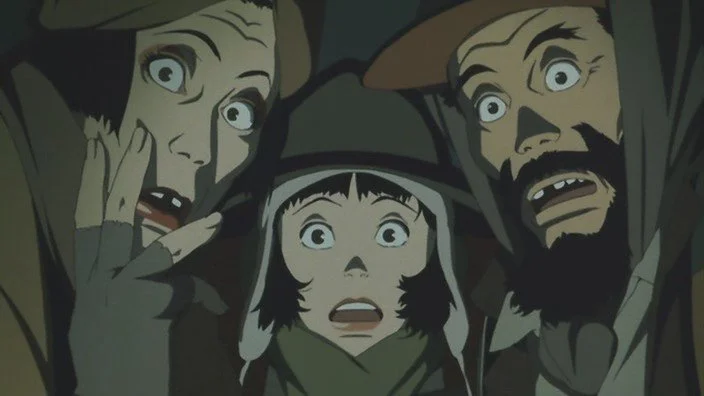
Fig. 1 - Hana, Miyuki, and Gin (Satoshi Kon, 2003).
This blog will discuss how Kon humanises Hana, Gin, and Miyuki as people regarded as social outcasts in society by grounding homelessness within the theme of family. As one of Tokyo Godfathers’ main ideas, family allows Hana’s character to be seen as more than just a crude transgender stereotype. By forming a found family with Miyuki and Gin, she emphatically takes on the role of a mother, an identity that she holds deeply to herself as a transgender woman. This is evident in how she initially treats Miyuki, nagging her about manners as if she were her own daughter. Hana’s desire to become a mother is soon validated after finding the baby, and she believes that she was destined to raise her. When confronted with keeping the child, Hana reveals her past to Miyuki and Gin, and the movie offers a sympathetic side to her character. She does not want the baby, whom she named Kiyoko, to grow up in foster care like she had, not knowing who her mother was or what love felt like. Hana wants to be a good mother for Kiyoko - someone better than her own. She deeply cares for her and cradles her as if she were her own baby. Hana’s passion for motherhood is what helped keep Kiyoko alive; she was driven by a selfless desire to care for and protect this child, no matter what dangers they all faced. It was ultimately her love for Kiyoko that made her instinctively leap off a rooftop to save her from death.
While Gin may be likened to the stereotype of a homeless man, he is humanised by his journey, starting out broken and hopeless, and ending up redeemed by reconnecting with the family he had abandoned. At first, he fabricates a tragic backstory to hide his shame, stating that he had lost both his wife and daughter after throwing a fraudulent cycling race in order to pay for his daughter’s medical bills. While the story is not true, it builds initial sympathy for Gin when the audience does not know what actually happened. Later in the film, Gin is shown to be an altruistic person by helping a dying elderly man from freezing in the cold. He takes him to a tent and stays with him so he would not die alone without anyone or any family to care for him. Gin then offers him a final taste of alcohol before he passes.
Not long after, Gin and the dead man are cruelly beaten by local teenagers. Gin is left injured and alone, and as he struggles and collapses on the ground, he calls out the name of his daughter. While Gin may have estranged himself from his family because of his drinking and gambling problems, he is still a father, and he still loves his daughter. He had even saved money so he could one day give it to her. While that money was spent on Hana’s health, he is still reunited with her at the hospital. When she spoke to him, he was not greeted with anger, but with acceptance and kindness. Kiyoko offers her and her mother’s address so that he can let them know he is still welcome home.
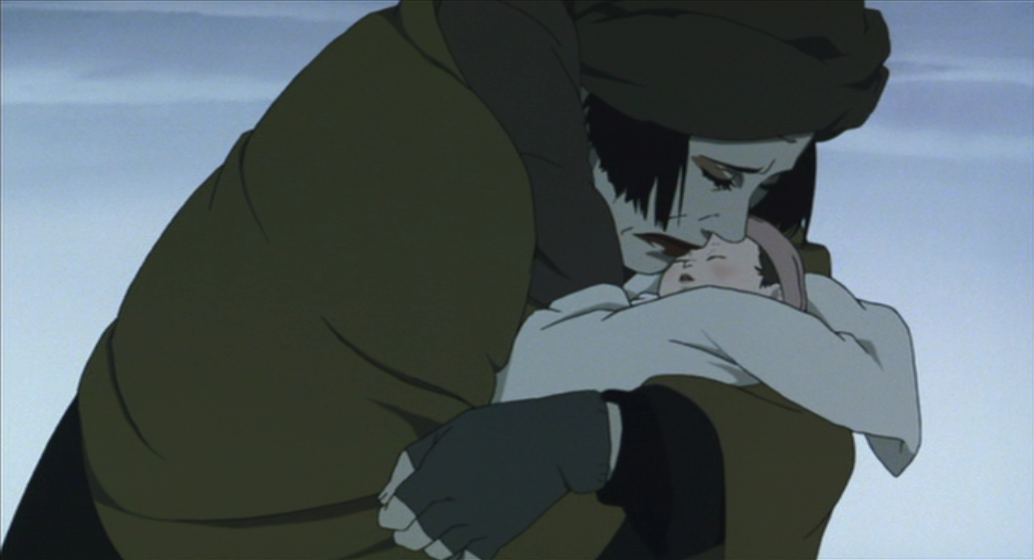
Fig. 2 - Hana holds Kiyoko in her arms.
Miyuki’s story as a teenage runaway is not unlike the former two, even though she is young. She is a girl who, like Gin and Hana, ran away from her family because of guilt, and this humanises her because she is flawed and tries to escape from her problems. While Hana had left her foster mother after fighting with one of her customers, and Gin left his family because of his excessive alcohol consumption and gambling, Miyuki left her parents because she had stabbed her father. She is afraid of what her family, particularly her father, thinks of her, and she does not want to confront her problems for fear of punishment. Her parents, however, just want her home safe. Directly tied with Hana and Gin’s stories, the trio’s biggest enemy is their own shame that haunts them. They all believe that the people they have left still hate them, despite it not being true. Miyuki encounters her father at least twice in the city: near the beginning of the film when he spots her on a train, and at the end of the film when she stays with Hana and Gin in the hospital. While Miyuki was first avoidant of her father, even being unable to speak with him on the phone, her journey may have prepared her to confront him. The film ends with their reunion because, ultimately, this baby had salvaged the three from their destitution and brought them back to their families.
In Tokyo Godfathers, Kon humanises the homeless by depicting a trio that cooperates like a family to protect a child, ultimately leading them to return to their old lives as they attempt to reunite the baby with her own parents. Through Hana’s nurturing nature and unconditional love for the infant (Fig. 2), Gin’s altruism and journey to redemption, and Miyuki’s gradual overcoming of her own fears, Kon is able to craft a story that perfectly shows complex characters that are beyond just social stereotypes and positively represents a population of people who are often forgotten by mainstream society. The mistreatment of homeless people is rarely spoken about. Even in the film, there are instances where Kon shows how the characters have been ostracised and ignored by the larger body of people in the city. Moreover, society never looks into the lives of the people who end up on the streets. In an article from the journal Housing, Theory and Society discussing the causes of homelessness, Peter Somerville suggests that understanding it involves seeing it as “multidimensional phenomenon” created by personal histories and the absence of relationships that may involve “unconditional care and commitment, based on kinship and/or kindness” (Somerville 2013). This directly relates to how the trio in Tokyo Godfathers thought they had lost the love and support of their families as soon as they revealed their reasons for leaving them. In essence, Kon was able to create a story that involved believable reasons why a person could end up homeless. It is through his clever direction that he urges the audience to see homeless people as complex and multifaceted, because above all, they are human beings.
**Article published: December 19, 2025**
References
Somerville, Peter. 2013. “Understanding Homelessness.” Housing, Theory and Society 30, no. 4 (January): 384-415.
Biography
Jade Sonnakul is a graduating student at the University of Texas at Dallas, Harry W. Bass School of Arts, Humanities, and Technology. Her focus is on animation and digital arts, but she wants to explore writing as well. Earlier versions of this text were developed with the help of Dr. Christine Veras and peers from the Animation Studies course.