
Isle of Dogs (2018) as a Love Letter to the Japanese Culture
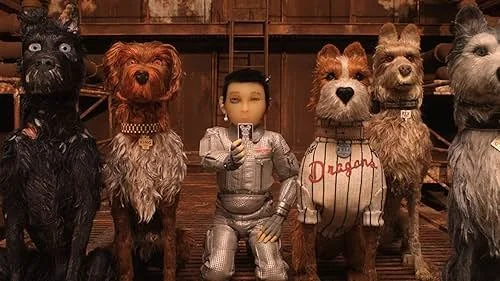
Fig. 1 - Isle of Dogs (Wes Anderson, 2018).
When Wes Anderson unveiled his new stop-motion film Isle of Dogs in 2018, audiences perhaps expected another symphony of symmetry, irony, and warm absurdity. But here the action had shifted to Japan — a country whose aesthetic seems to reflect Anderson's style: strict and ritualistic, yet poetic and meaningful. Needless to say, Anderson has always been a Japanophile with a profound respect for Japanese art. "Some of the main inspirations for the film were Kurosawa's film noirs of the early 1960s, The Bad Sleep Well (1960) and High and Low (1963),” said Isle of Dogs production designer Nathan Harrod (qtd. in Desowitz, 2018). Indeed, Megasaki, the fictional city where the story unfolds, looks like a futuristic version of Yokohama from High and Low in particular, while Mayor Kobayashi is based quite directly on actor Toshiro Mifune, who played businessman Gondo in the Kurosawa’s film.
Isle of Dogs (Fig. 1) is one of Anderson's most culturally rich films. In this blog post, I propose viewing the film not as another visual experiment, but as a product influenced by Japanese aesthetics. These influences function not as stylistic gestures, but rather shape the film’s very structure: its rhythm, pauses, theatricality, composition, and even political tone. And this, in my view, is precisely the value of this new reading — it allows us to see a familiar film as the result of the encounter of two artistic traditions that do not imitate each other, but create a new meaning, made possible only by their fusion.
The main action of Isle of Dogs takes place on Trash Island (Fig. 2), where the authorities of Megasaki exile all canines. It is a space of absurdity and decay, crafted with immense attention to detail, but this time the aesthetics of "perfect chaos" are transformed into a metaphor for the human world—or, more accurately, a metaphor for social marginalia. The inspiration here is Kurosawa's later work, particularly Dodes'ka-den (1970), a little-known but incredibly nuanced film about life in a garbage dump. There, as in Anderson’s tale, poverty and alienation are transformed into surreal poetry. In both cases, the image here is an island of pain, home to those society has cruelly discarded.
The city of Megasaki in Isle of Dogs is not quite cyberpunk with neon and advertisements, and neither is it Japan with its retrofuturist cliches, but a neat blend of minimalism, 1960s modernism, and traditional Edo motifs. Here you can find ribbons of hand-drawn paper on doors, signs written in kanji, and architecture inspired by the Tokyo 1964 Olympics.
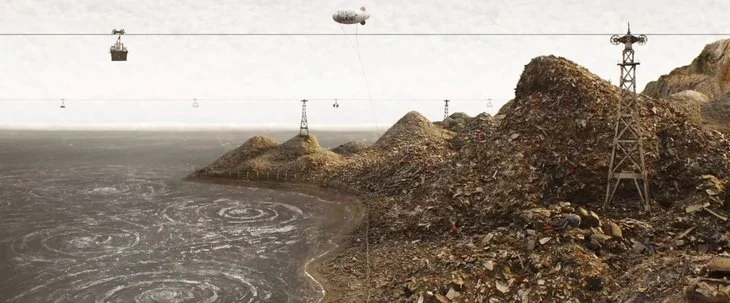
Fig. 2 - Trash Island.
The film's cinematographer, Tristan Oliver, called the visual style of Isle of Dogs "almost anti-photographic" (qtd. in Robertson 2018). He avoided directional lighting, preferring diffused lighting and minimal shadows, giving everything the appearance of being under a gray sky. This approach evokes the aesthetics of Japanese woodblock prints of the Edo period by Hokusai and Hiroshige. They lack deep perspective, but instead possess clarity, order, and rhythm. Even the legendary Mount Fuji appears in Anderson’s film not as a backdrop, but as an essential element of the landscape, completing the composition. Almost every frame can be viewed as a separate woodblock print — flat, yet filled with movement, emotion, and life.
Most modern stop-motion films such as Kubo and the Two Strings (Travis Knight, 2016) or Pinocchio (Guillermo del Toro & Mark Gustafson, 2022) use smooth facial animation: the change of emotions occurs over a number of intermediate frames. But the animators of Isle of Dogs deliberately limited the number of expressions, using only 12-14 key forms (Failes 2018). In Kabuki theatre, there is the concept of mie — the moment when an actor freezes at the emotional climax of a scene. It is a pose, a look, a turn of the head — a moment in which all the energy of the action is compressed. In these seconds, the audience applauds: the actor is not acting, he becomes the emotion.
In Isle of Dogs, Anderson literally animates mie. When Kobayashi or the boy Atari's face changes from sadness to anger in a single frame, it is precisely that—a frozen manifestation of emotion, where the abruptness of the transition takes on a ritualistic quality. Anderson's camera, known for its stillness and symmetry, here even more closely resembles a theatrical space. Almost every shot in Isle of Dogs is a scene in which the characters are positioned frontally to the audience, like actors on a stage. The soundtrack throughout the film, with its rhythmic drums, plays the role not just of a soundtrack but of nagauta—live accompaniment, as in Kabuki, where drums and flutes comment on the narrative. The moments of “peace and rhythm” that Anderson notices in Miyazaki's work become the soul of Isle of Dogs. Between the turbulent scenes of fights, propaganda, and technology, silence suddenly descends. This is what the Japanese call ma (間), or negative space. It is not just emptiness, but an artistic understanding of the space between things, which has the same significance as the forms themselves: pause, silence, anticipation set the rhythm and imbue the work with meaning. It can be perceived not only as a physical gap in the paintings, but also as a sense of an interval filled with possibility — that very silence between notes.

Fig. 3 - Godzilla vs. Mechagodzilla (Jun Fukuda, 1974).
If Megasaki is Kurosawa and Hokusai, then the mechanical dogs hunting the heroes are already Godzilla vs. Mechagodzilla (Jun Fukuda, 1974) (Fig. 3), another facet of Japanese culture — techno-mythology. Anderson's dogs are not just animals, but samurai. Their devotion to their masters, their sense of duty, their inner honor — all of this embodies Japanese bushido. On top of that, the stop-motion style of the film works a bit like the old practical effects in classic Godzilla movies, which gives the dogs the same handmade, slightly theatrical feel.
Anderson does not fully explain Japanese realities to the viewer. On the contrary, almost all lines in Japanese that are spoken in the film remain untranslated. Their meaning is instead conveyed by interpreters or visual cues. In a world where cultural appropriation has become a sensitive topic, Anderson chose the path of respectful dialogue, in which he does not adapt to the non-Japanese-speaking viewer . Anderson managed to combine Western narrative and Eastern form. Isle of Dogs does not copy Japan, does not show what it should be—it speaks to it. He does not use Japanese aesthetics as a masquerade, but as a way of thinking fulfilling the storytelling purposes in a cinematic finesse.
**Article published: February 20, 2026**
References
Failes, Ian. 2018. “‘Isle of Dogs’: Animation Director Mark Waring Explains How ago Animate Wes Anderson Film.” CartoonBrew. Available at: https://www.cartoonbrew.com/feature-film/isle-dogs-animation-director-mark-waring-explains-animate-wes-anderson-film-157358.html.
Desowitz, Bill. 2018. “‘Isle of Dogs’ How Team Wes Anderson Created a Stop-Motion Love Letter to Japanese Cinema.” IndieWire. Available at: https://www.indiewire.com/features/general/isle-of-dogs-wes-anderson-stop-motion-animation-japanese-cinema-1201942149.
Robertson, Barbera. 2018. “The Visual Effects of Wes Anderson’s ‘Isle of Dogs’.” Animation World Network (April 18). Available at: https://www.awn.com/vfxworld/visual-effects-wes-andersons-isle-dogs.
Yang Rachel. 2018. “Unrolling the Masterful Sushi Scene in ‘Isle of Dogs’.” Variety: https://variety.com/video/isle-of-dogs-puppet-master-film-broke-animators/.
Biography
My name is Rasul Kuramagomedov. I'm studying at Newcastle College University Centre in the BA Animation program. Since childhood, I've been fascinated by the vast worlds that only animation can offer. I focus on storyboarding and 3D animation in particular, but I've also begun to gain knowledge in screenwriting and cinematography.