Hazbin Hotel: The Villain is in the Details, and the Threshold Between Fantasy and Reality
Thinking about Clarence Boddicker’s glasses from the film RoboCop (Paul Verhoeven, 1987) while sitting on the bench outside of the library at around quarter past two in the afternoon, Sebastian sits next to me.
I ask the following: “If Hazbin Hotel became novelised, each book dedicated to a character, when it hits Valentino, who would you want to write him?’”
“George Saunders. He’d get into his head.”
Sebastian’s answer rang a fresh thought across my mind that lingered in my brain for a while until, feverishly, I started noting the bones of this down.
Hazbin Hotel is an animated fantasy series about demons in Hell. The protagonist, Charlie Morningstar, is a Disney princess; a China cup of hot chocolate with a pink chrysanthemum on top poured into a melting pot of sour grapes, bitter apples, and unquenchable libidos. It’s also a musical. This is rather important, as a musical production is one in which “song, dance, speech and movement…entertains, informs and amazes you” (Leon 2010, 11). Created, produced, and released as a pilot on YouTube by animator Vivienne Medrano, or Vivziepop, it is one of the most popular animated web shows. The pilot, released on YouTube on October 28th 2019, currently has a view count of 122 million and 421k comments. Amazon Prime Video premiered the first season, which received a positive reception, on January 19th 2024.
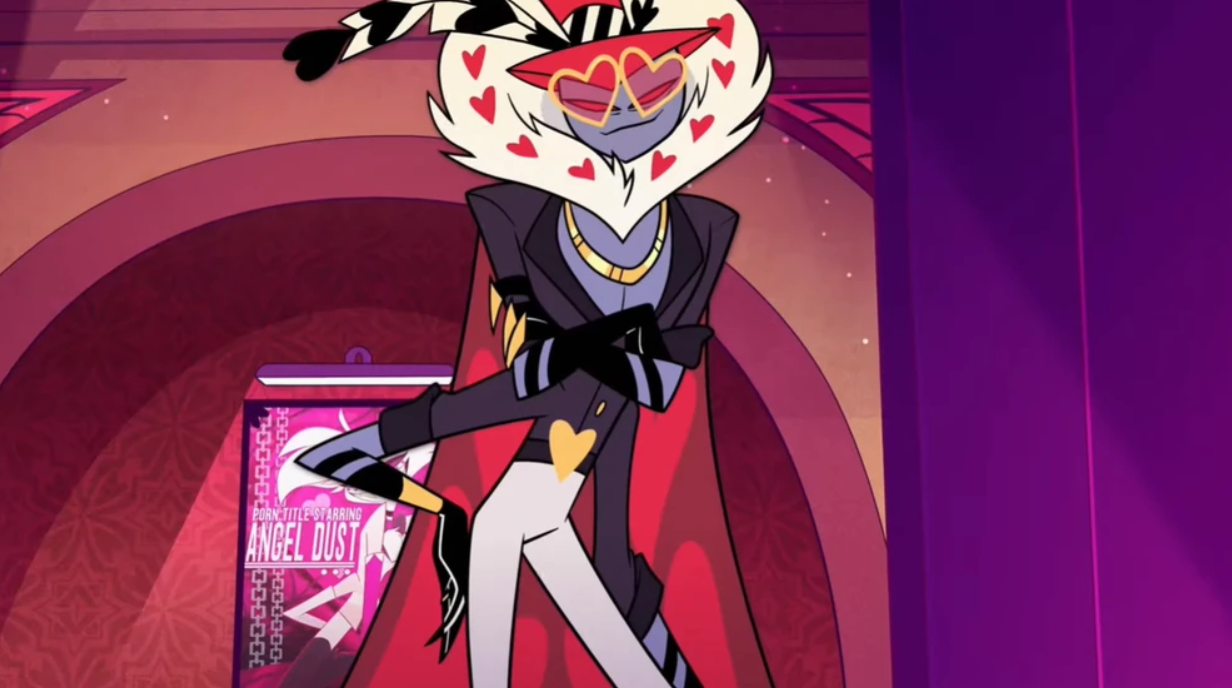
Fig. 1- Valentin in control.
The cast, aside from the delightful Charlie, consists of many roughs and loveable rogues. We have Charlie’s girlfriend, and an ex-Angel Executioner with a badass voice, Vaggie; Angel Dust, the sultry pornographic performer that everyone in Hell recognises; the bitter armadillo-shelled bartender Husk; the psychotic one-eyed maid Niffty; and the nefarious radio, partial wendigo, overlord, Alastor. There are many more, such as the honourable, mechanically gifted Sir Pentious, but we would be here forever. One of the joys of Hazbin Hotel is that each character is undoubtedly charming, gifting the audience their chaotic presence, the equivalent of a pantomime where the actors have had too much to drink and any moral compass or decency was shot out of the window with a middle finger and a cocaine-laced cigarette from the vending machine. Simply, the fantasy of the forgivable criminal, the socially inept, lovable screw-ups, is nothing but intoxicating because between the television and us, there is a gap where we can see a fragment of ourselves, tap-dancing on their animated, spikey shoulders.
However, these are merely the good chaps. The show is in Hell, after all. Where are the proper “bad” folk? Let us become familiar with one of these villains, the aforementioned Valentino (Fig. 1). There is no beating around the bush. Valentino is deplorable, evil, manipulating, son-of-a-bitch, the rug-puller, the invisible blue in the visible red, the sledgehammer that the show smacks you with over the head.
His first appearance, while admittedly comedic, carries a certain severity just enough to disquiet the nominal viewer. We enter his chambers, and hidden in an alluring yet dizzy red smog, he almost falls out of his Freudian sofa, throws his drink on the ground (with a stein coming out of the corner of his mouth), demanding another, and proceeds to complain like a child. Well, this is a rather pathetic display. But the physical and environmental details of his golden tooth, the robotic servants, and his unique “vocal thumb print” (Alburger 2015, 218) (performed excellently by Joel Perez) regarding his immense displeasure with Angel Dust endorsing Charlie’s hotel stagger in comparison to the surface-level, comedic impressions. He may lack decent hindsight, but the first five seconds are a grotesque display of an unpredictable villain who protrudes a horrifying dominance akin to what Andrea Dworkin described as “the power of terror…naming…owning” (1981, 24), to weaken and destroy the possibility of rehabilitation to make himself the corrupted aurea mediocritas: “You think you can change? Addict trash like you doesn’t change. I’ll see you soon, baby.”
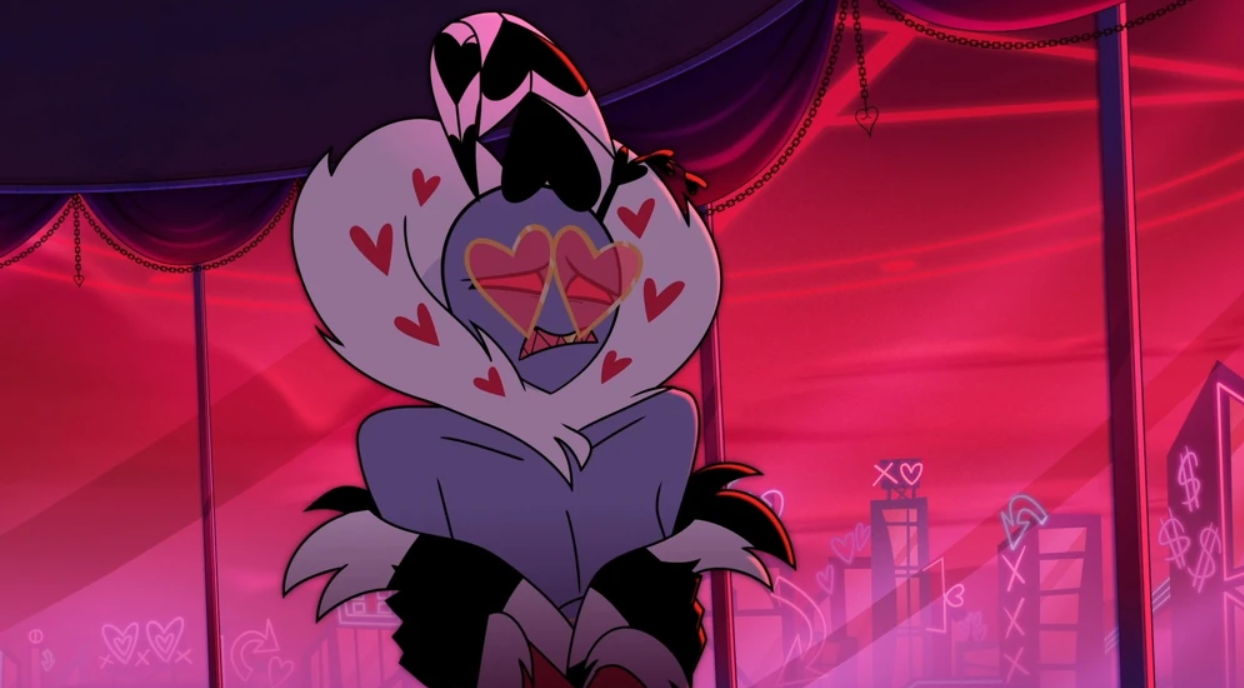
Fig. - Valentino is vulnerable.
Midway through season 2, this intimidating image begins to falter as the main head honcho of the Vs (a collective of which Valentino is a proud member), Vox, seems to have a greater effect on Valentino than expected. There is one scene in particular that highlights this, and once more, it is in a comedic interaction. When Valentino and Velvette question Vox’s intentions on his plan to rally the citizens of Hell, and whether or not the two could be allowed to bask in their glory, not his and only his alone, Valentino says this after Vox’s attempts to hypnotise him fail:
“You know that freaky eye shit doesn't work on me! Plus, I don't even know why you're asking. You just do whatever the fuck you want anyway, all for that stupid fucking plan of yours, right? And this whole thing? [motions to Alastor currently tied to a chair] It’s getting old fast, Vox!”
The gap opens. Valentino is susceptible to jealousy (Fig. 2). Valentino demands that Vox not force himself onto him. Valentino is displaying what Zeb J. Tortorici describes, in the context of gay pornography, a “seemingly submissive masculinity” (2008, 205) in the face of a higher power. In a suggested translation of his tirade in Spanish, he cannot understand why Vox does not appreciate his beauty. Vox’s response to this is to demean him, simply saying that he does not understand Val’s “island language.” This results in him getting a bottle to the face and Val exclaiming that he is from Florida. Needless to say, Valentino dislikes being taken advantage of. Now, where have we seen that before?
Another, and perhaps the most verbose example, is in Valentino’s part of the song “When I Think About the Future” in season 2 episode 7 “Weapon of Mass Distraction”:
“Val, don't be dramatic / He's just a man / He's being rude 'cause he's stressed out / Trying to do his master plan, think about the future, Val / Don't let success break up the band, but as he rises higher, things aren't like they were before, and if he glows any brighter will he see me anymore?”
This song and lyrics transcend Valentino into a three-dimensional monster whose desire for love, protection and attention is just as basic and real to our messy, collective desires. It is important to understand that, as Jessica Page Morrell notes, “sympathy doesn’t necessarily stem from likeability” (2008, 197) as George Saunders emphasises about writing characters with unfavourable traits, that it is better for them to be human rather than a “static…terrible concept” (2022). From how I spoke of Valentino, he intruded Hazbin Hotel’s quirky fantasy with a treacherous dread. Yet ambiguous questions fill the space. What’s his idea of love? What happened to him before he died? Was he a victim of the industry he revels in? He’s afraid of being alone. What makes a character worth investing in is to show them at their most vulnerable. At the end of the day, everyone is susceptible to weakness. Valentino is no different. Underneath the nightmare lies a tumultuous centre riddled with hypocrisy and fear. It is this deeper understanding of character that always guarantees their memory not only for the show and its writing, but also for the character individually. Valentino is definitely one of those.
**Article published: May 8, 2026**
References
Alburger, James R. 2015. The Art of Voice Acting: The Craft and Business of Performing for Voiceover. 5th edition. Burlington, MA: Focal Press.
Dworkin, Andrea. 1981. Pornography: Men Possessing Women. London: The Women’s Press.
Leon, Ruth. 2010. The Sound of Musicals. London: Oberon Books.
Morrell, Jessica Page. 2008. Bullies, Bastards and Bitches: How to Write the Bad Guys of Fiction. Cincinnati, OH: Writer’s Digest Books.
Saunders, George. 2022. “‘Could I understand the people who rushed into the Capitol?’: George Saunders on how stories teach empathy.” The Guardian, October 15, 2022. https://www.theguardian.com/books/2022/oct/15/could-i-understand-the-people-who-rushed-into-the-capitol-george-saunders-on-how-stories-teach-empathy.
Tortorici, Zeb J. 2008. “Queering Pornography: Desiring Youth, Race, and Fantasy in Gay Porn.” In Queer Youth Culture, edited by Susan Driver, 199–216. Albany, NY: State University of New York Press.
Biography
Daniel Appleby is an autistic writer and poet currently residing in Cornwall and is pursuing an MA at Falmouth University. Daniel has always loved fantasy and horror ever since he was a teenager. This would lead to his admiration for Joel Lane, Adam Marek, Robert Shearman, and Matthew Holness. There are too many to count. Daniel has expanded towards international literature from Japan to Iceland. His favourite movies are Little Miss Sunshine, Dead Man’s Shoes, Ju-On: The Grudge, and Fantastic Mr. Fox. He has been published in Witch House, The Horror Zine, Discretionary Love, and many more. Find him on Instagram at @danie_lappleby.