Analysis on Hoodwinked!’s Failed Animation
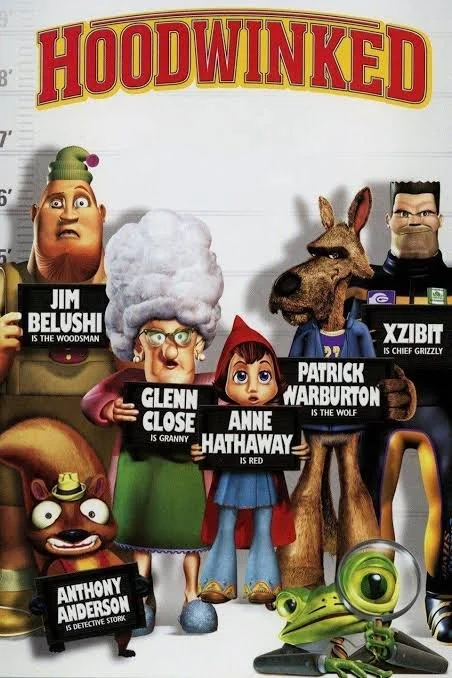
Fig. 1 - Hoodwinked! (Cory Edwards, Todd Edwards & Tony Leech, 2005).
Directed by Cory Edwards, Todd Edwards, and Tony Leech, Hoodwinked! (2005) is an animated retelling of the story of Little Red Riding Hood with an investigative twist. The story is told from the conflicting perspectives of Red, the Wolf, Granny, and the Woodsman as a frog detective tries to solve the case of the goodie bandit and a stolen recipe (Fig. 1). The film has received praise for its humour, but has been widely criticized for its stiff and uncanny computer animation. In this blog post, I will analyse how the animation of Hoodwinked! was negatively affected by a combination of budget and technological constraints, as well as a failure to apply major foundational animation principles, resulting in poor character performances and a sense of unease during an era of popular computer-animated filmmaking.
The production of Hoodwinked! was started somewhat on a whim. While at the Sundance Film festival for a film Todd Edwards had directed, one of their investors, Maurice Kanbar, told the brothers that they were interested in making an animated film. According to Cory Edwards in a recent interview, despite having worked for a handful of animation studios, the duo ultimately did not know what they were getting themselves into (see Pulaski 2024). This unease felt by the brothers was made evident when the investor asked them to produce an animated film, and they only requested around two million dollars to make it, which was approximately one percent of the cost for the usual commercial animated films of that early 2000s period. Cory further claimed that Kanbar was the sole investor for the film. By the end of Hoodwinked!’s production, the film ended up costing just shy of 8 million dollars to create. However, during its release, reports were made on the film that were falsely inflating the price of the film’s production, saying that the film took 15 to 20 million dollars to produce (Pulaski 2024).
Hoodwinked!’s miniscule budget ended up limiting the filmmakers, as it had left both Todd and Cory with very little wiggle room for any changes made after pre-production and forcing them to stick with a majority of the mistakes they might have made. Due to their inability to make changes further down the production track, they were forced to spend much more time on their pre-production, in order to prevent as many future changes as possible. The beginning of the film’s pre-production was all done by the three directors in Pasadena. Both Cory and Todd drew out storyboards with Tony Leech cutting them on an iMac (Pulaski 2024). Once they had received funding, they went to the Philippines to have it animated.
The filmmakers have stated that the film’s style was inspired by stop motion animation and that the characters were meant to look like figurines. Unfortunately, the film was not entirely successful in its stylisation. The characters lack the textures that would perhaps have been present if it were done in actual stop motion. Yet they are also missing the smoothness of CGI, leaving the film in an awkward in between state. Not only that, but due to outsourcing their animation abroad, the Edwards brothers were not able to have as much of a presence to ensure the style was being kept properly during the actual animation process.
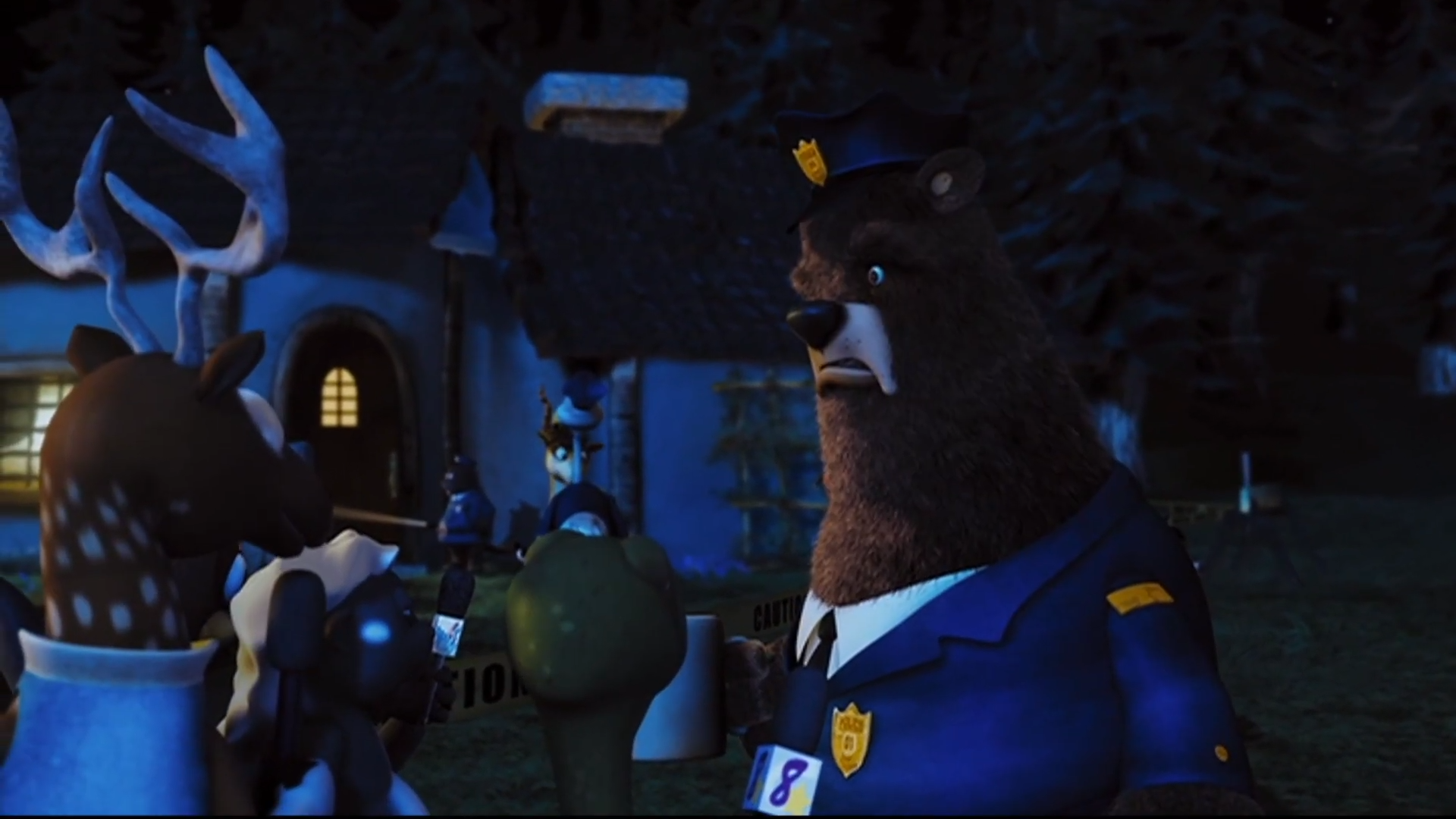
Fig. 2 - Screenshot from Hoodwinked!.
Hoodwinked! also fails to implement core animation principles related to the design and movement of animated characters, like squash and stretch, anticipation, timing, and follow through (see Furniss 2016, 103). This problem with character is present throughout the entire film but is shown right from the start within the first 5 minutes. Just 2 minutes and 30 seconds into the film we see police surrounding Granny’s house and a police officer bear gets out of their vehicle and before making their way towards the house, is immediately bombarded by reporters asking questions about the situation. They ask if the incident is related to the Goodie Bandit, and if the house is made of gingerbread. Already we are shown a major flaw in the animation, the staging. The camera is focused on the bear, leaving the other animals out of focus and facing the backs of the reporters (see Fig. 2). This makes it difficult to clearly tell who is speaking (Johnston and Thomas 1981, 56). As a result, the entire time the bear is walking up to the house and speaking to a fellow officer, the camera is facing their back, preventing the audience from viewing the character’s faces. Due to the character’s faces being obscured, the audience is deprived of the emotion of the character, leaving all of the emotional heavy lifting to the voice actor. Immediately, the poor animation is made apparent. The animal’s movements do not have any anticipation to them, movements start and end without any preparatory movement while also lacking any follow-through, as they just freeze once their main action is completed. The bear cop (while being asked questions by a reporter) only moves when they are responding, yet their head moves independently from the rest of their body. This is an issue with all of the characters throughout the entirety of the film, but is especially apparent from a beaver cop in the same scene. The character’s head and torso move side to side but not only do neither their feet nor their eyes move, they are not even properly planted on the ground. Not including the levitating, these stiff and sudden movements end up making the characters reminiscent of old animatronics or robots, leaving the audience with a feeling of unease (Johnston and Thomas 1981 52).
The animation in Hoodwinked! is severely lacking in several of the major defining principles of animation character, and appears as though it were a heavily rushed rough draft. However, the failings of this film’s animation largely stem from the constraints caused by its shoestring budget, rather than its writing. The film’s budget limited access to better software, required the film to be largely outsourced, and prevented the filmmakers from making adjustments past pre-production. Ultimately, Hoodwinked! serves as a lesson on how production conditions and constraints can hinder the final animated product.
**Article published: November 27, 2026**
References
Furniss, Maureen. 2016. A New History of Animation. New York: Thames & Hudson.
Pulaski, Steve. 2024. “Cory Edwards Shares Details on the Production of Hoodwinked!, What Went Wrong with Sequel | Y105.” YouTube, available at: https://www.youtube.com/watch?v=Q0Ta4wXfocY.
Thomas, Frank, and Johnston, Ollie. 1981. The Illusion of Life: Disney Animation. New York: Disney Editions.
Biography
Oja Kaiser is a graduating student at the University of Texas at Dallas, Harry W. Bass Jr. School of Arts, Humanities, and Technology with a degree in Animation and Games. Their focus is on background and character design, with interest in drawn animation. They hope to pursue a career in preproduction and teaching art. Earlier versions of this text were developed with the help of Dr. Christine Veras and peers from the Animation Studies course.