A Look Back: “Why do we pursue creativity?”
Look Back (Kiyotaka Oshiyama, 2024).
Look Back (2024), directed by Kiyotaka Oshiyama and written by Tatsuki Fujimoto, explores the emotional struggles involved when maintaining artistic motivation, told through the story of protagonists Fujino and Kyomoto. Through an expressive use of animation sound, and colour, the film immerses viewers in a narrative that examines the complicated relationship that artists often have with creativity as they seek validation and self-worth. This blog will analyse how Look Back, along with its manga counterpart, portrays the emotional complexities of creative ambition, burnout, and identity, while reflecting the internal conflicts many artists face when the passion in their art begins to waver.
Look Back concerns two artists, Fujino and Kyomoto, who both have a passion for drawing. Fujino is an artist who loves to be praised by external figures, such as her family, friends, or classmates, which is one of her biggest motivations for drawing (Fig. 1). In contrast, Kyomoto is a reclusive artist who fears social interaction, yet her motivation to create comes purely from her love of drawing. Their paths cross when Fujino, confident in her skills, is confronted with Kyomoto’s better artistry when visible in their class newspaper’s manga panels. Their exchange causes Fujino to question her abilities, sparking a journey between Fujino struggling with self-doubt and pressure to improve and Kyomoto who learns to escape her artistic isolation. Through their rivalry and friendship, the film explores creativity’s emotional highs and lows that change how each character thinks of what it means to be an artist.
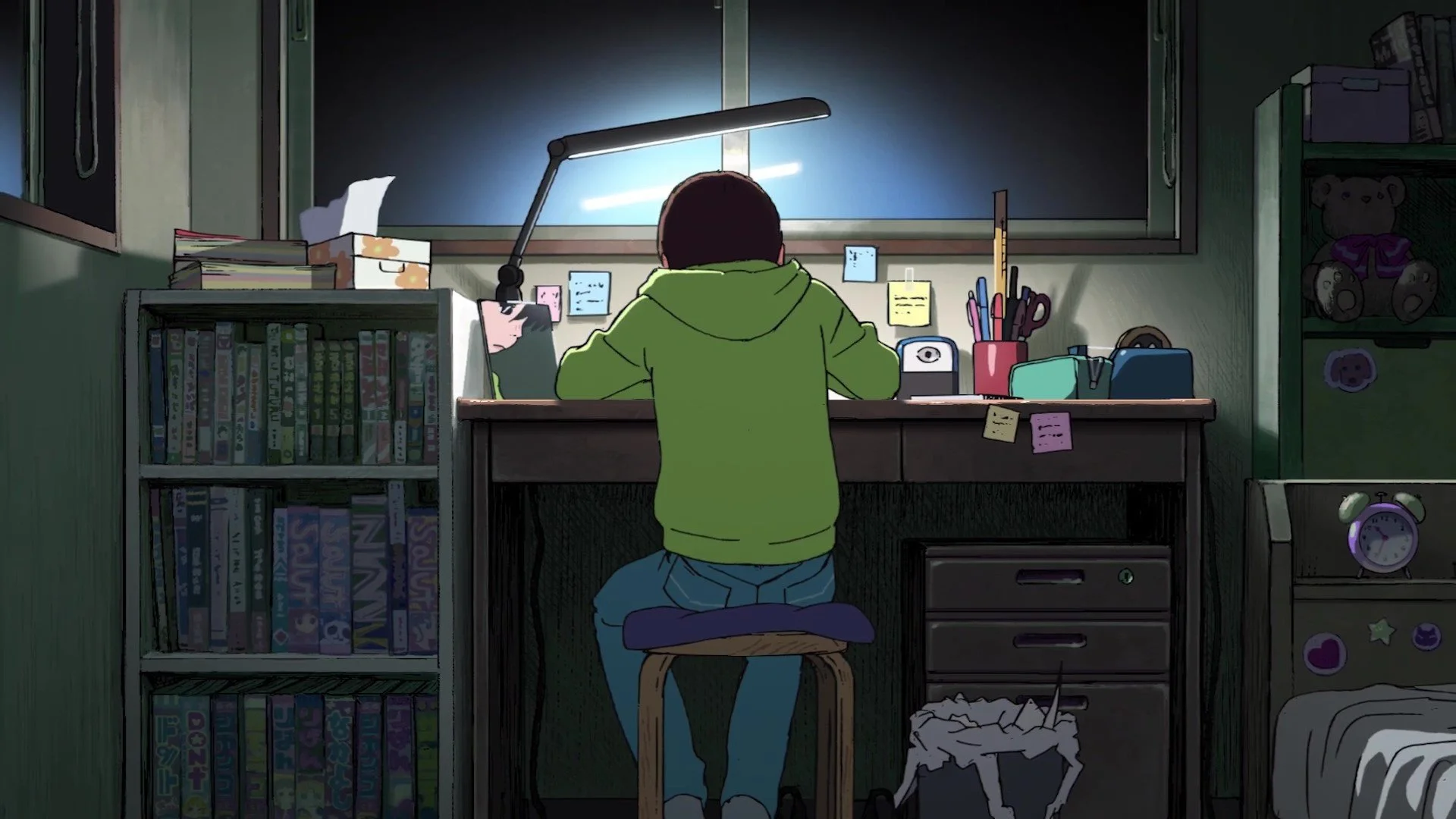
Fig 1 - Fujino buries herself in creativity.
On a personal level, I have experienced creative burnout and doubt regarding the worth of my artistic works. Despite my academic success, I felt disconnected from the passion that initially drove me. This time of uncertainty has made me more aware of stories that explore similar emotions, such as burnout and lost (and the quest for) meaning. In this frame of mind, I returned to Look Back, and its themes resonated with me profoundly differently than in earlier viewings. What had previously been a beautifully animated film now felt deeply personal, offering a look into the emotional realities of the creative process.
This internal struggle is something Look Back captures perfectly through Fujino’s journey. Initially, Fujino is seen as a talented artist, admired by her classmates and family. Her identity is tied to her artistic ability, but when she sees Kyomoto’s detailed and beautifully drawn manga panels in the school newspaper, her confidence is shattered. Feeling her talent has been overshadowed, she throws herself into intense practice, sacrificing time with family and friends in an obsessive attempt to improve. We see her drawing tirelessly through different seasons, day and night, fall and summer, pushing herself beyond exhaustion. But despite all her efforts, when she sees another edition of the school newspaper, she realises that her work still doesn’t measure up to Kyomoto’s. At this moment, she gives up. She quits drawing entirely and instead redirects her focus to spending time with family and trying other activities.
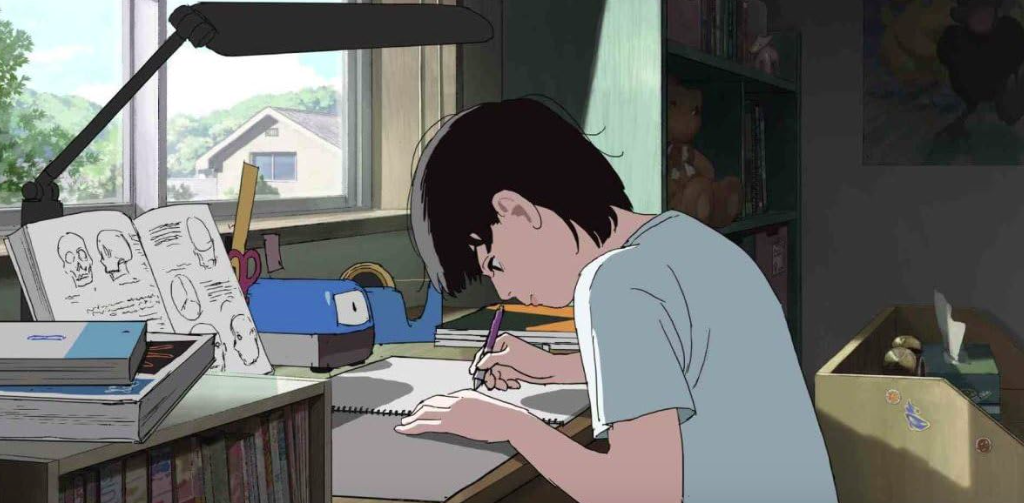
Fig. 2 - Fujino in Look Back.
Look Back has quite an interesting feel. In terms of its animation style, it stays faithful to the manga almost entirely, “shot by shot”, which is quite rare in manga-to-anime adaptations (see Schley 2024). At the same time, the film builds on those graphic shots, adding more character and feeling, with the camera movement making the film feel like an indie artist directed it. Some sequences that stand out are the beginning of the film, where the shot begins from an aerial shot of the sky, slowly zooming into where Fujino lives and where she is drawing, making the cover come to life (Fig. 2). This sets the tone for the story.
This attention to detail in the animation enhances the emotional narrative. The transitions between Fujino’s initial confidence and struggles are shown by colour and sound design shifts that mirror her internal struggles. In these clips, you can see that for moments where she has success, that brings brighter colours and uplifting music. This choice reinforces her character’s journey and brings the audience along.
As Fujino’s drive to improve her art begins to waver, the film also shows the impact of external validation on an artist's psyche. Initially, Fujino was motivated by the praise she received, showing that a significant theme of the film is how much the opinions of others can control an artist’s feeling of worth. This relationship between validation and creativity raises the question of authenticity. Are we creating for ourselves, or are we simply looking for approval? This is a problem many artists, including myself, face.
Meanwhile, Kyomoto’s character presents a contrasting view of artistry. Her reclusive personality allows for her motivation to be fuelled solely by passion. While she also faces her problems, her path shows the beauty of creating art for the pure enjoyment of creation, with no need or desire for external validation. This difference between Fujino and Kyomoto serves as an exploration of different artistic paths and philosophies.
The film’s climax presents an essential moment in Fujino’s character as she confronts her identity as an artist and person, which leads her to realise that being an artist is not just about talent or fame. It is about the journey, growth, and connections we form. I resonate with this theme in my own experiences during my recent period of burnout, reminding me that creativity is less about comparison and more about personal expression and fulfilment.
In conclusion, Look Back offers more than an animated story about artistic rivalry or self-improvement. It dives into the emotional complexities of creativity, self-worth, and every artist’s journey of discovery. As Sarah Miller states in her review of the film, “‘Look Back’ is not just a film — it’s an experience that lingers long after the credits roll. It’s a masterful meditation on grief, resilience, and the invisible threads that connect us.” As I ‘look back’ on my struggles and what this film has shown me, I find a renewed sense of my purpose in my creative works. By embracing the highs and lows of my journey, I can reconnect with the passion that drives me to tell stories. Through the eyes of Fujino and Kyomoto, I am reminded that creativity is a deeply personal pursuit that evolves alongside our life experiences and emotions.
**Article published: January 16, 2026**
References
Miller, Sarah. 2025. “Review: ‘Look Back’ Is Short but Powerful.” The Rice Thresher (January 31, 2025).
Schley, Matt. 2024. “‘Look Back’: A Tale of Self‑Discovery and Tragedy Told at a Refreshing Pace.” The Japan Times, (June 26, 2024). Available at: https://www.japantimes.co.jp/culture/2024/06/26/film/look-back-anime-review/.
Biography
Emmanuel Rocha is a student at the University of Texas at Dallas, Harry W. Bass Jr. School of Arts, Humanities, and Technology. His focus is on Game design, while also enjoying 3D modeling and filmmaking. He loves animation in every form. Earlier versions of this text were developed with the help of Dr. Christine Veras and peers from the Animation Studies course.