The Hidden Critique of Capitalism Inside Cyberpunk: Edgerunners (Hiroyuki Imaishi, 2022–)
When Cyberpunk: Edgerunners (Hiroyuki Imaishi, 2022–) was released, it quickly gained attention for its intense action, emotional storytelling, and striking visual style. Set in the same universe as Cyberpunk 2077, the series dives into the chaotic world of Night City—a place where technology is advanced, but human life often feels disposable. At first glance, it looks like a fast-paced sci-fi story about crime and survival. But beneath that surface, Edgerunners offers something more subtle. It presents a sharp critique of capitalism, one that is built directly into its world, characters, and visual language.
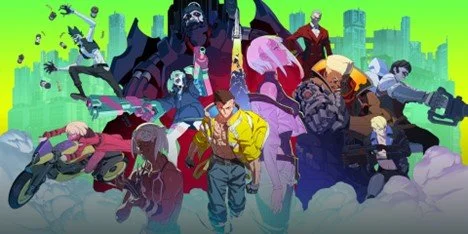
Night City is not just a setting. It is a system. Everything in it revolves around profit, power, and consumption. Corporations dominate every aspect of life, from healthcare to security. People are valued based on what they can produce or how much they can spend. This is not presented through long explanations. Instead, the series lets the environment speak. Advertisements fill the screen. Technology is everywhere, but access to it depends on money. The world feels alive, but also deeply unequal.
The story follows David Martinez, a teenager from a lower-income background who is trying to survive in this system. His journey begins with a simple goal: to get a good education and build a better life. But even this basic ambition is shaped by economic pressure. After his mother dies, he quickly learns that opportunity in Night City is not equal. Education, safety, and even dignity come at a cost. Without money, those things disappear.
This is where the critique becomes clearer. The system does not fail David. It works exactly as intended. It pushes him toward risky choices because those are the only options available to him. Becoming an edgerunner—a kind of mercenary operating outside the law—is not just rebellion. It is survival. The series shows how capitalism can create conditions where illegal or dangerous work becomes the most logical path forward.
Technology plays a key role in this world, but it is not presented as purely positive. Cybernetic enhancements allow characters to become stronger and faster, but they also come with a price. Not just financially, but physically and mentally. The more upgrades a person installs, the closer they get to cyberpsychosis—a state where the body and mind begin to break down. This idea reflects a deeper message. In a system that values productivity above all else, even the human body becomes something to optimise and exploit.
Cyberpunk: Edgerunners (Hiroyuki Imaishi, 2022–) - Official Trailer
David’s transformation throughout the series shows this clearly. At first, his enhancements help him succeed. He gains confidence, power, and status. But over time, the cost becomes visible. His body starts to fail. His sense of self begins to blur. What looks like progress is actually a form of slow destruction. The system rewards him in the short term, but it cannot sustain him in the long run.
Other characters reflect similar patterns. Lucy dreams of escaping Night City entirely, which already says a lot about how the world is built. Success is not about thriving within the system, but about leaving it. Maine, another key figure, represents what happens when someone pushes too far. His decline is not sudden. It is gradual and inevitable. The pressure to keep going, to keep upgrading, to keep earning—it never stops.
Visually, the series reinforces these ideas in subtle ways. Night City is full of light, colour, and movement. It looks exciting, even attractive. But there is always something overwhelming about it. Screens flash constantly. Ads appear everywhere. The environment feels crowded and noisy. This creates a sense that the city is always demanding attention, always pushing people to consume more and move faster.
At the same time, there is a clear contrast between spaces. Corporate environments are clean and controlled. Everything looks organised and efficient. In contrast, the areas where edgerunners operate feel chaotic and unstable. The difference is not just aesthetic. It reflects access to resources and power. Order exists where money exists. Chaos fills the gaps.
The series also avoids presenting a clear “villain.” Corporations are powerful, but they are not personified in a single character. Instead, they function as part of the background. This makes the critique feel more realistic. The problem is not one individual. It is the system itself. People operate within it, benefit from it, and are also harmed by it.
What makes Cyberpunk: Edgerunners especially effective is that it does not deliver its message in an obvious or heavy-handed way. The critique of capitalism is there, but it is woven into the story rather than stated directly. Viewers experience it through the characters’ struggles and choices. This makes the impact stronger. Instead of being told what to think, the audience is invited to notice patterns and draw connections.
This kind of storytelling fits well within the cyberpunk genre, which has always explored the relationship between technology and power. But Edgerunners feels particularly relevant today. The idea of constant optimisation, of turning personal identity into something productive or profitable, is familiar to many viewers. Even outside the world of the show, people curate their online presence, build personal brands, and navigate digital spaces shaped by algorithms and platforms. In that sense, the themes of Edgerunners extend beyond fiction.
At the same time, modern digital culture also creates new forms of connection. People meet, communicate, and build relationships through online tools in ways that were not possible before. Platforms that encourage interaction—where users can discover CallMeChat and similar services—show a different side of technology. They highlight how digital spaces can also be used for communication, community, and expression, not just profit. This contrast reflects the same tension seen in Edgerunners: technology can empower, but it can also control.
Animation as a medium plays a big role in delivering this message. The exaggerated style allows the series to push its ideas further. The speed of movement, the intensity of colour, and the fluidity of action all contribute to the feeling of overload. At the same time, quieter moments are given space to breathe. This balance helps ground the story emotionally, even when the world itself feels extreme.
In the end, Cyberpunk: Edgerunners is not just a story about crime or technology. It is a story about a system that shapes people’s lives in ways they cannot fully control. It shows how ambition, survival, and identity become tied to economic pressure. And it does so without losing its emotional core.
David’s story is not unique within this world. That is what makes it powerful. It feels like one version of many similar paths. The system continues, regardless of individual outcomes. People rise, fall, and disappear, but the structure remains.
That is the hidden critique at the centre of Edgerunners. It does not shout. It does not simplify. Instead, it builds a world where the consequences of capitalism are visible in every choice, every upgrade, and every loss. And by the end, it leaves a quiet but lasting question: in a system like this, what does it actually mean to succeed?
**Article published: April 17, 2026**
Biography
Linda Carpenter is an accomplished writer and content strategist with a passion for crafting stories that inspire and engage readers. She specializes in creating compelling narratives for digital platforms, blending creativity with insight to connect brands and audiences. When she’s not writing, Linda enjoys exploring new cultures, sipping artisanal coffee, and collecting vintage books.