The Animation in the Cauldron: Asterix's Magic Potion on Screen
A history of animation aesthetics could be written simply by watching a Gaul drink the potion of Getafix the druid, in that famous quarrelsome village nonchalantly defended from Roman conquest by Asterix and Obelix, the indomitable duo born from the imagination of René Goscinny and Albert Uderzo in 1959. In the recent Netflix television series Asterix and Obelix: The Big Fight (2025), Asterix, having downed a sip of the magic brew, soars into the air and begins to change colour, transforming into cyan, magenta, and then yellow; the three colours of print. These colours do not settle evenly across his body, but sit slightly off-axis, or rather, out of register, as printers say when the ink levels are not properly aligned (Fig. 1). In fact, for this latest Asterix series, production designer Aurélien Predal wanted to recreate the effect of the printed page during this sequence. In the inevitable brawl that follows the drink, the Gauls sweep through the Roman ranks, leaving behind the word "TCHRÂÂÂÂÂC!!!”, one of the French-style onomatopoeias patented by Uderzo.
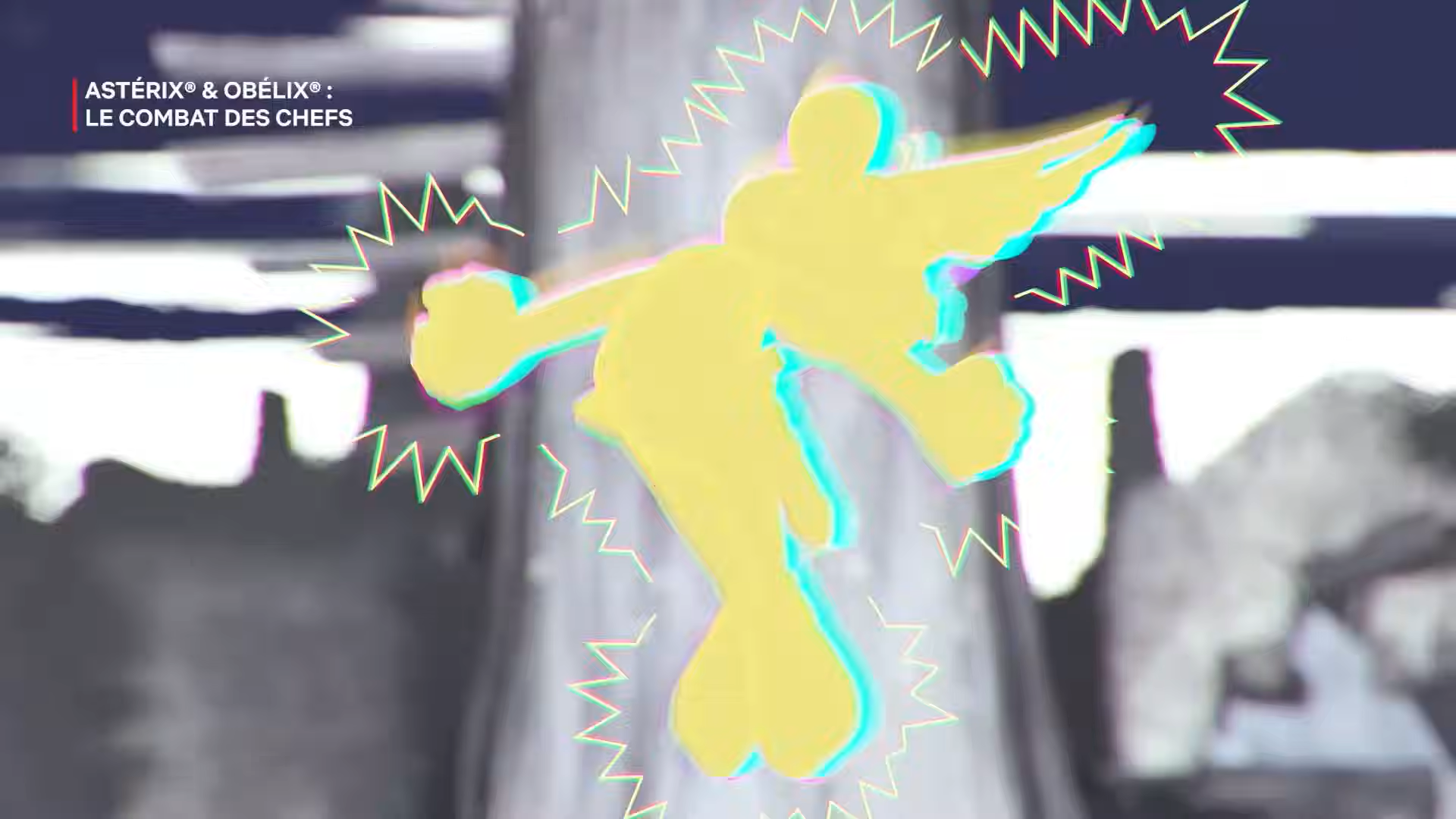
Fig. 1 - Asterix soars into the air, the colours out of register.
Ever since Miles Morales showed the way to the multiverse, a new generation of animation directors has thrown itself in headfirst: 3D now shares space with 2D, with video games, with painting, with stop-motion, and indeed with comic-book print, and other media universes. Comics bring their texture – and their imperfections – back to the screen: out of nostalgia for the printed page, to make the visual experience richer, or perhaps in response to a certain kind of digital animation now perceived as cold and expressionless. "We wanted to explore a more tactile look that would bring a warmer and more tangible aspect to the CG," said Alain Chabat, co-director of The Big Fight, when speaking to Animation Magazine.
As in the opening panels of every Asterix album – a map of Gaul under Roman occupation, with that small Armorican village circled by a magnifying glass – this piece will focus its lens on the same patch of land to study a single recurring visual motif: the moment a Gaul drinks the magic potion brewed by Getafix, the village druid (Fig. 2). The potion grants superhuman strength, and its effects on the drinker's body have been rendered differently in every era of the saga’s animated history. These variations are a small but telling index of sixty years of changing aesthetics in Asterix and European animation.
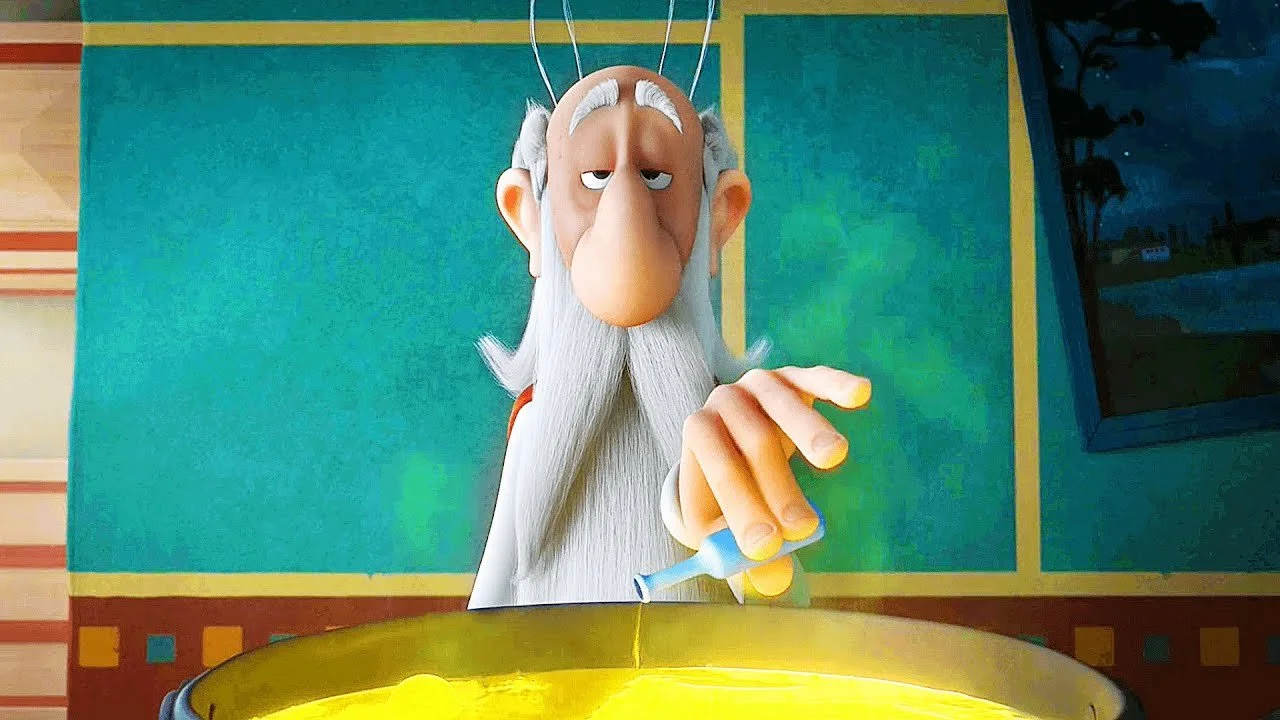
Fig. 2 - Getafix, the village druid.
Back in 1967, at his first animated appearance, Asterix had no immediate reaction to the potion. We see him running at full speed a few seconds later, but at the moment of drinking, no stars, no colours, no explosions. For all we know, it could be a placebo. Perhaps Getafix still needed to perfect the formula – and alongside him, so did Georges Dargaud, the comics publisher making his first foray into film production. European animation in the 1960s was somewhat groping its way as it tried to leave the world of television and reach cinemas. Uncertain of his footing, Dargaud stuck faithfully to Goscinny and Uderzo's first story, without managing to capture its spirit – and without, for that matter, involving the two of them in the production. The aura is lost, literally: in the printed saga, Asterix's first sip of the potion gives him a halo of yellow energy that is entirely absent from the film.
With the two godfathers brought on board to direct the sequel Asterix and Cleopatra (1968), the potion is back to taking immediate effect. This time, the animation lets loose: Asterix contorts, shoots flames, flashes, spins, rotates – a kind of European tracing of the more anarchic animations of the American tradition, which had already made Popeye's muscles burst at the seams thanks to his spinach, one of Goscinny's explicit inspirations for the magic potion. In Dr. Jekyll and Mr. Mouse (1947), for example, another famous duo – Tom and Jerry – finds itself dealing with a poisonous concoction devised by the former to do away with the latter. Jerry's convulsions and explosions are not so different from Asterix's, and the consequences are identical: the mouse acquires superhuman strength, giving rise to an unlikely cat hunt. Dr. Jekyll and Mr. Mouse came out twenty years before the Gauls landed in Egypt; twenty years after, another peculiar magic potion – a bourbon – would send Roger Rabbit's limbs into the same kind of frenzy. Of course, Dargaud's budget in 1967 was not particularly generous, and corners had to be cut somewhere: the second time Asterix drinks the potion in Asterix and Cleopatra, the animations are recycled.
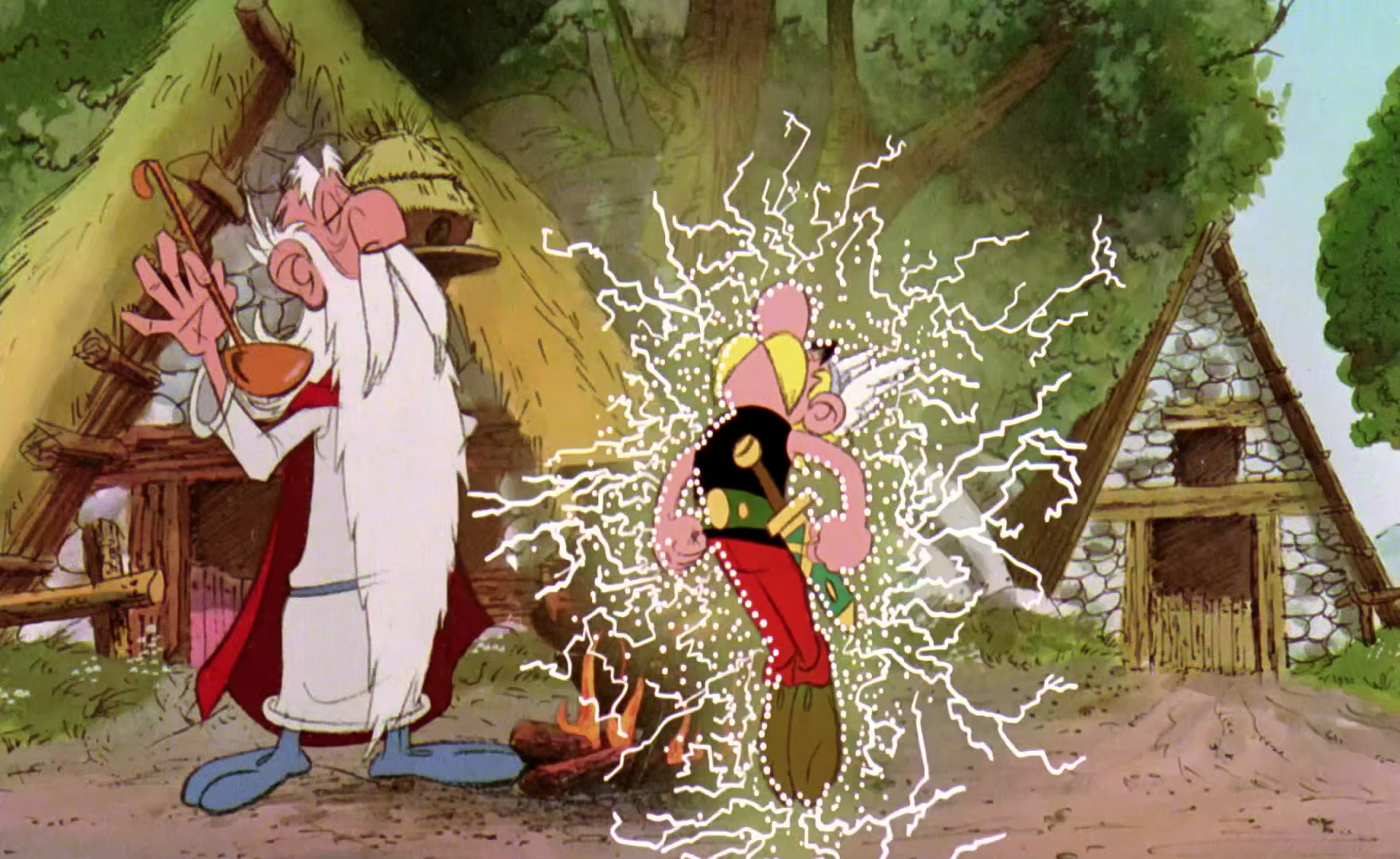
Fig. 3 - The charges and the dots trace Asterix's outline.
Perhaps the most elegant transformation came with The Twelve Tasks of Asterix (1976), the second theatrical adventure from the druidic duo Goscinny and Uderzo, who for the occasion ventured into an original screenplay. A remedy for Olympic-scale labours, this version of the potion makes the background colour vibrate, sets the wings of Asterix's helmet flapping, lifting him into flight, and sends bursts of luminous energy radiating from his body (Fig. 3). Small dots of white light trace his silhouette, and from somewhere deep within him a kind of white scribble emerges, gathering around his heart. An iconographic power worthy of one of the most ambitious animated productions ever undertaken in Europe – fittingly, the film stages what is perhaps the continent's most beloved depiction of bureaucracy, “The Place That Sends You Mad,” against which Getafix’s potion is utterly powerless. That imaginative drive would be lost with Goscinny's death and Uderzo's growing indifference toward the saga's animated projects, which from then on, with very few and unremarkable exceptions, would render the arrival of superhuman forces as a simple yellow glow around the characters – sometimes limited to the eyes alone – barely a flicker compared to the creative solutions that came before.
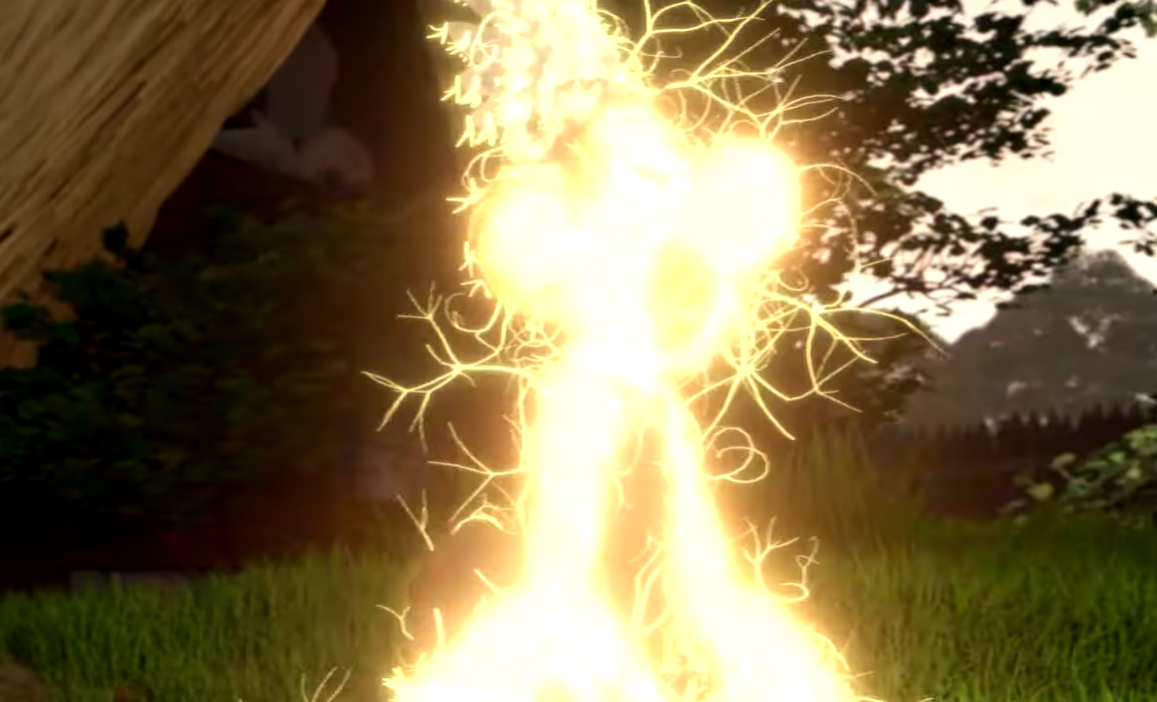
Fig. 4 - An electrified Asterix lights up like a lightbulb.
In the 2000s, meanwhile, the developers of the saga’s video games would seize on the magic potion as the most straightforward of temporary power-ups (available, naturally, only to Asterix), while the VFX artists of the live-action films would conjure the most unsettling acts of violence inflicted on the face of a French actor since Un Chien Andalou (Luis Buñuel, 1929). In 2014, Asterix would receive his first fully digital animated body on the big screen in The Mansions of the Gods. Here the drink has an electric effect – we are on computers, after all. We watch a charge spread through him, tracing his nervous system. Sparks scatter through the air, announcing mastery of particle effects (Fig. 4). Asterix, of course, knows nothing of any of this: for him, “electric” is just a name for Goths.
The one constant visual choice among European animation artists has been not showing us what would have happened to Obelix had he drunk the potion. Some things are better kept secret. In the finale of The Mansions of the Gods, he is allowed just a single drop. The camera pulls back to an extreme wide shot: we no longer see Obelix, but we hear a demonic roar and watch buildings crumble. What has always remained visible, though, is the hand stirring the cauldron. Perhaps, with the wisdom of a druid who sees beyond the boundaries of the screen, Getafix has made the powers of his animators his own. At its most potent, his potion animates the Gauls: it fills their bodies with the will to fight, but also with movement, spectacle, expression. Tracing its effects across sixty years of adaptations reveals, each time, something of the druid-animator who crafted it. Getafix’s cauldron, it turns out, might always have been an inkpot.
**Article published: April 24, 2026**
Biography
Federico Cadalanu is a PhD student at the University of Bologna, where he is conducting a research project on the European animation industry. He is currently a visiting researcher at Liverpool Hope University and King’s College London. He is a programmer for the human rights film festival Movies that Matter in the Netherlands, and has served as editorial coordinator for the Mercato Internazionale Audiovisivo (MIA). He has written about the audiovisual industry and culture for The Hollywood Reporter Roma.