Projecting the Extrareal: Theatrical Animation, Reality and The Book of Dust
What is animation’s relationship to the real? Much of animation scholarship – from Sergei Eisenstein’s glowing affection for ‘plasmatic[ness]’ to the newly codified photoreal (1998, 46) – dedicates itself to the pursuit of this question, probing the structures and ontologies of our inherently fantastic medium. As comprehensive as these critiques are, however, the vast majority refuse to question animation’s greatest obstacle to reality: the screen. Like its live-action cousins in film, most animation remains bounded by a flat plane, unable to interact with the tangible dimensions of our landscape. The advent of projected animation (a lamentably untheorised field!) explodes these boundaries, as the animated ‘real’ ventures beyond the surface and into the physical world of stagecraft.
The Book of Dust - La Belle Sauvage (2021) - Trailer
In this blog post, I interrogate how projected animation interacts with the politics of live performance: specifically, how its conscious artifice operates in coordination with the synchronous reality of bodies on a stage. To achieve this goal, I take as a case study ten seconds from The Book of Dust (2021), one of the National Theatre’s most daring experiments with a projected playscape (see left). Reckoning with the fantastic elements of Dust’s plot, I contend that combining animation and live performance creates an extrareal state – a conceptual mode blending tangible reality with projected unreality, in which playgoers actively choose to render their own experience fantastical. In this light, projected animation is freed to embrace experimentation; invoking a curious synthesis of plasmatic and hyperreal styles, its practitioners expand beyond both physical and animated realisms. I argue that Dust’s daemons – animal puppets representing the human soul – stand as the ultimate beneficiaries of the extrareal state, acting as a tangible bridge between ‘real’ actors and the ‘unreal’ landscape.
Before live performance, a note on juxtaposing animation with live-action cinema. Unlike its animated counterpart, live-action film acts as an index to the real world (Moszkowicz 2002, 296); even those films that revel in their artifice (Wes Anderson’s filmography springs to mind) carry more evidence of realism than a cartoon. Jan Svankmajer describes animation as a “means of subvert[ting]” this indexicality, “cast[ing] a doubt over reality” itself (qtd. in Wells 1998, 11). However, when animated simulacra share the screen with live-action characters – as in Disney’s mid-century hybrids or Who Framed Roger Rabbit (Robert Zemeckis 1988) – the result becomes not subversion, but a reminder of the film medium’s artificiality. Watching Eddie Valiant slope around his office, a viewer might conflate his world with our own – but Roger’s pneumatic motion startles us out of this equation, reasserting unreality and the startling primacy of the fourth wall.
On the stage, however, the boundaries between fictional and ‘real’ reality grow increasingly fluid. Watching a play, the audience member is brought into direct contact with the theatrescape, aligned not only by their shared physical space but by the axis of temporality. Live performance invokes what Gertrude Stein refers to as “syncopated time,” a subjective temporality operating “in relation to the emotion of anybody in the audience” (Stein 1967, 450). This intimate investment blurs the lines between fiction and lived experience, as the viewer undergoes the play’s events with the same emotional cues that propel the chronology of her life. Submerged in such a symbiotic mode, theatrical realities are simultaneously relieved from and subject to greater pressures of realism. Audiences, swept along by the syncopated current, grant performance license to extend beyond the superficially realistic – but their expectation that theatrescapes adhere to internal reality remains vital, shifting the burden of realism onto emotional truth.
When animation enters the stage, therefore, it necessarily acts as a catalyst for that truth. In The Book of Dust, the breaking of the priory window signifies a shift in narrative mode, pivoting from ordinary life to the stylised drama of the flood. Filipe J. Carvalho, the production’s (somewhat fancifully named) ‘Illusions Designer’, dramatizes this transition through a dynamic sequence of projected animation, the shattered panes of the priory giving way to roiling floodwaters. Accompanied by an almighty sonic crash, the moment grounds Dust’s dramatic landscape – and yet Carvalho’s design also bespeaks a plasmatic unreality. The fragments of the windows fall light as leaves, seemingly without the pressure of gravity; detaching his animation from the impetus to signify real windows, Carvalho instead prompts the viewer towards an emotional iconographic reading. A curious doubling occurs, in which the viewer simultaneously experiences the intensity of the scene and metabolises its symbolic potency.
In effect, Carvahlo’s sequence evokes unreal animation to heighten theatrical reality, uncovering the playscape’s emotional truth. Annabelle Honess Roe, discussing animated documentary techniques, describes “the aesthetic quality of … animation” and its potential to “carr[y] meaning in its own right” (2013, 44); in a dramatic context, this aesthetic potential not only instils a unique meaning, but enables the wider thrust of the playtext itself. Dust’s juxtaposition of realities – real actors overwhelmed by an animated storm – facilitates its stylistic shift, as the audience find themselves translated to an alien and suddenly fantastic landscape.[1] Unlike in live-action cinema, however, this intervention of animated unreality only heightens the audience’s investment in the scene. While animation awakens the viewer to live-action film’s inherent artifice (not real life, but an index to it), projected animation reminds her of the theatrescape’s essential emotional truth. Immersed in theatre’s syncopated time, the theatregoer willingly chooses to implicate herself in fantasy.
This willing implication, in which audience members immerse themselves in an unreal playscape, constitutes what I define as the extrareal. Rather than perceiving fantasy from the safety of the couch, participants in the extrareal forsake external realities; instead, they willingly suspend disbelief, engaging their own subjective reality in a fantastic performance. Animation acts as a vital component of this extrareal experience, the medium’s blatant unreality elevating the synchronic realities of the stage. Perhaps the closest analogue to this relationship stems from Gregory Barsamian and his kinetic sculptural animation. Suzanne Buchan describes Barsamian’s practice thus:
“[His] purpose is to re-invent a new architecture for experiencing animation, one that re-focuses the eye and mind away from the shadowy illusion of flat images to behold the reality of a concrete object in space.” (2013, 277).
Just as Barsamian’s reorientation of animation exposes the reality of concrete objects, animation’s theatrical ‘architecture’ works to ‘re-focus the … mind’ on the physical playscape. By connecting physical reality to its unreal potential (the projection on the window, offering visions into a new world), animation provides the viewer a conduit into a deeper reality of fantasy and emotion.
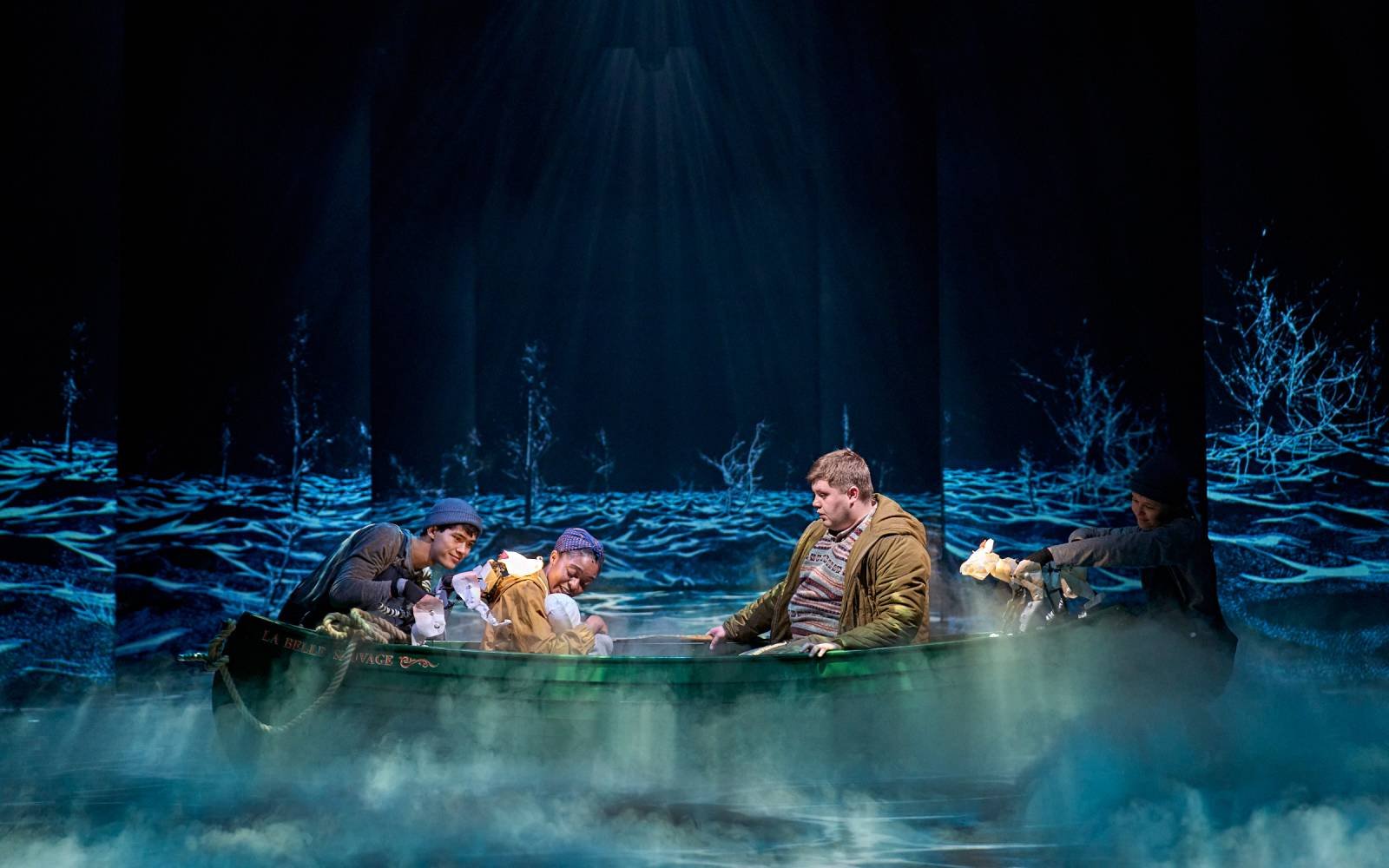
Fig. 1 - Manuel Harlan - Thames scene with projected animation (Bridge Theatre, 2021): https://bridgetheatre.co.uk/whats-on/the-book-of-dust/.
How, then, can the extrareal operate? To gain a greater insight into the potential of this brave new mode, we must return to The Book of Dust. After the windows shatter, a torrent of shifting water engulfs the stage . Carvahlo represents this flood with a dramatically condensed visual palette, his river achieved by projecting the white crests of waves onto set. Indeed, it is the movement of these crests that primarily suggests their ‘riverness’; accurately depicting the frantic flow of currents, Carvahlo animates the Thames with a hyperreal naturalism (Fig. 1). This hyperrealism places Dust’s flood within the frame of reference of our reality, capable of posing a genuine threat to the play’s protagonists.
Carvahlo’s Thames may be hyperreal in its currents, but the river’s monstrous metamorphosis speaks to a plasmatic influence. Bursting through the windows, the flood rises, monolithic, to encompass the entire playscape. When two actors, balanced precariously on a bridge, shout out across the stage, their faces are dappled with projected waves; even the human body has become a vehicle for the overwhelming animation. This forceful metamorphosis – backdrop swelling to overtake foreground – resonates strongly with plasmaticness and, specifically, the logic of ‘cartoon physics’: defined by Scott Bukatman as a series of “physical laws” that “propose an alternative set of means by which bodies navigate space” (2014, 303). Bukatman theorises that these laws operate exclusively “in the service of humour” (2014, 303) – but, combined with Dust’s hyperreal illustration of current, I offer that cartoon physics here works to amplify the flood’s latent threat. Synthesising hyperreal motion with plasmatic proportions, Carvahlo taps into a vein of terror that simultaneously meets and subverts the audience’s known reality.
To achieve extrareality, however, the projected Thames must interface meaningfully with the corporeal playspace. As the first surge of water bursts, its plasmatic force ripples through the set; a mobile white flat (onto which a priory window was projected) shifts, moving seamlessly from stage centre to the wings. The effect is as if the Thames itself disturbs the flat, the animated flood physically changing Dust’s ‘real’ landscape. Thus subordinating the tangible theatrescape to unreal projection, Carvahlo – working in tandem with Set Designer Bob Crowley – undermines the logic of his audience’s previous reality. In the extrareal, the participant finds herself beyond realist knowledge systems, as she navigates a reality that revolves around emotion and symbol.
Not only does extrareality react against these physical logics, it also ‘animates back,’ responding directly to orthodox modes of animated reality. Sergei Eisenstein, rhapsodising on the joys of early Disney, nevertheless reserves his praise from one facet of the studio’s output: the “musicality of landscape” (1988, 98). Eisenstein notes a “disturbing stylistic rupture” between foreground and background, the grace of the foregrounded figures exposing a “childishly, pathetically tinted” landscape (1988, 98). Prior to the flood, Carvahlo’s projection design channels precisely this landscape. His backdrops, invoking the hatched shading and simplistic illustration of the novel’s cover, contrast sharply with the action onstage; further, a limited use of active projection (relegated to scene transitions or the slow fall of rain) distinguishes the animation from the actors, penning them in separate conceptual realities.
With the advent of the flood, Carvahlo’s animated landscape punctures Disneyfied conventions, as these separate realities merge into a cohesive extrareal state. In a reversal of the foreground/background principle, the newly dynamic Thames assumes centre stage; the principal actors are pushed to the corners of the set, marginalised by the projected maelstrom and its dramatic presence. Indeed, by endowing what was previously scenery with frenetic movement, Carvahlo fundamentally changes the status quo of orthodox animation, elevating his projected background almost to the status of a character. Dust’s extrareal mode here achieves an expansion not only of tangible reality but of animated realism, as its intermediality develops novel ways of articulating emotional truth.
In this landscape of extrareality, there remains one integral fantasy that we have yet to discuss. Together, projected animation and tangible theatrescape work to engage the participant in a deeper emotional reality: but what of Dust’s puppetry, a medium that exists simultaneously as real and animated motion? Some may contest this association of puppetry with the animated form – Norman McLaren’s famous assertion that animation is “the art of movements-that-are-drawn” (qtd. in Wells 2011, 13), for example, implies a premeditated process – but I maintain that, in the theatre space, the boundaries between performance and animation become increasingly blurred. When projected animation takes part in live stage events, a theatre technician ready to perform last-minute adjustments, the medium assumes a temporality like that of puppetry. Animation, after all, takes its meaning from the Latin verb ‘animato,’ the “action of imparting life” (“Animation”); despite superficial differences, theatrical animation and puppetry impart that same living quality in the same syncopated timeframe.[2]
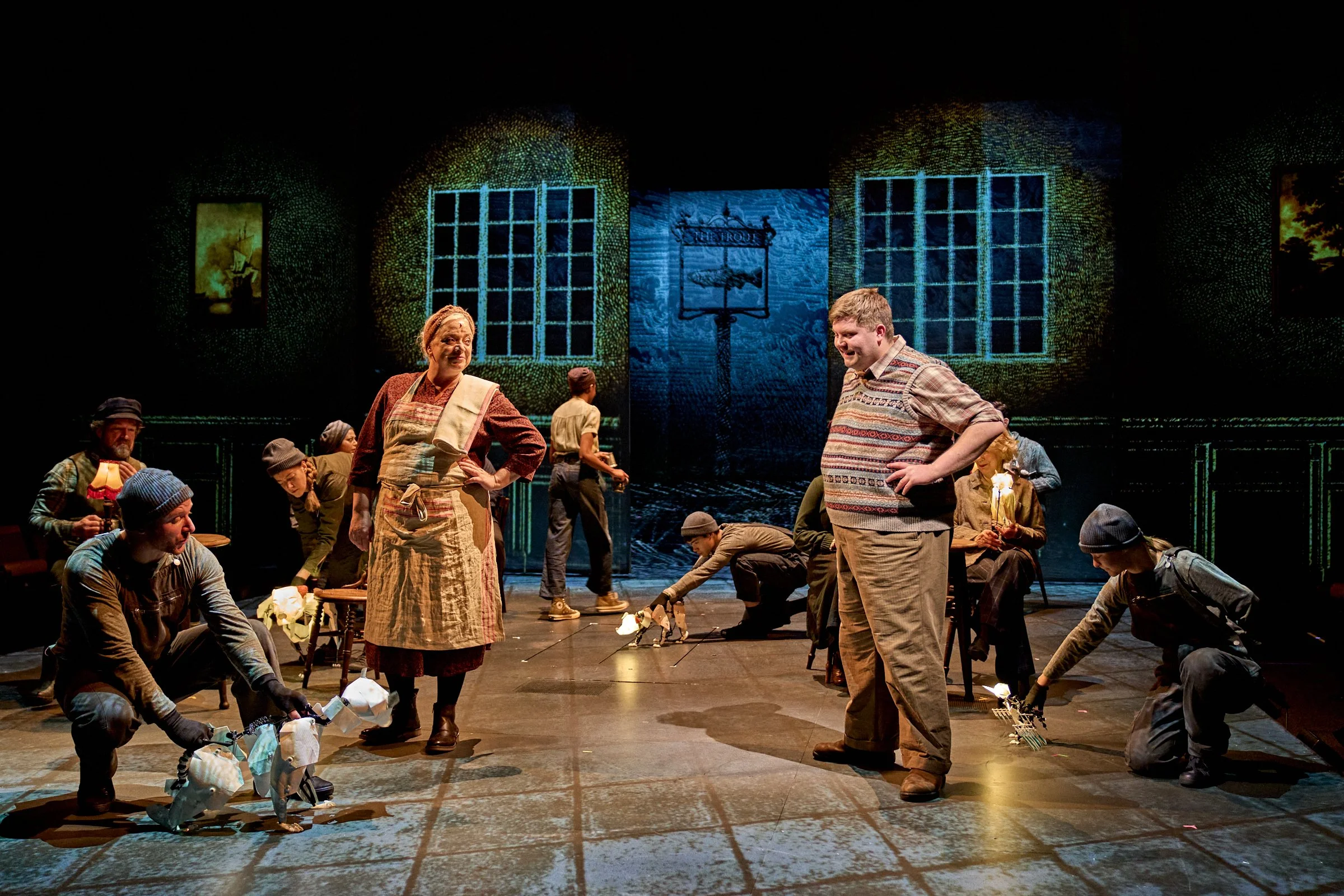
Fig. 2 - Manuel Harlan - Pub scene with daemon puppets (Bridge Theatre, 2021): https://bridgetheatre.co.uk/whats-on/the-book-of-dust/.
What’s more, Dust’s design team deliberately aligns its puppetry with the animated landscape. During the flood, puppeteer Olivia Le Andersen directs her daemon’s flight in jolting arcs: a deliberate echo of the waves’ rocking motion. The daemon’s movement situates puppetry between tangible realism and animated unreality, belonging not to the sombre logics of the physical world but the fantastical fusion of the extrareal state. Steve Tillis, comparing modern animation to puppetry, comments that both media “frequently h[o]ld up the mirror … to the untrammelled imagination of the … [a]rtist” (1999, 183). As a vehicle for Dust’s ultimate ‘untrammelled’ concept – the daemon, a physical manifestation of the human soul – puppetry represents perhaps the ultimate beneficiary of the extrareal mode (Fig. 2). Animation’s facilitation of extrareality paves the way for the daemon’s emotional truth, investing the audience in a theatrical reality where anything (including puppets!) can be believed.
To animate, Ronald Holloway suggests, is to “give life and soul to a design” through a complete “transformation of reality” (qtd. in Wells 1998, 10) – and via the extrareal, theatrical animation brings this ‘transformation’ to new heights. In The Book of Dust, Carvahlo’s projected illusions probe the boundaries of both tangible and animated realisms, while their interaction with the physical playscape manifests Dust’s emotional core. Through the power of this extrareal mode, animation becomes a truly revelatory practice, showing audiences everywhere new ways of experiencing the world around us.
**Article published: February 6, 2026**
Notes
[1] Interestingly, this mode represents a variation on pre-realist animation’s visual technique, which Julia Moszkowicz asserts “celebrate[d] disjuncture over fusion” (296). “Maintaining a distinction between image and object, animation and the world” (296), the breaking windows literalise Moszkowicz’ theoretical vision: a distinction between unreal animation and physical reality itself.
[2] Remember, too, that a pioneering technique of animated media was the zoetrope – a kinetic device that required a human interface to achieve its effect.
References
Buchan, Suzanne. 2013. “Take the B Train: Reconstructing the Proto-Cinematic Apparatus.” In Pervasive Animation, edited by Suzanne Buchan, 275-291. London and New York: Routledge.
Bukatman, Scott. 2014. “Some Observations Pertaining to Cartoon Physics; or, The Cartoon Cat in the Machine.” In Animating Film Theory, edited by Karen Beckman, 301-316. North Carolina: Duke University Press.
Honess Roe, Annabelle. 2013. Animated Documentary. London: Palgrave Macmillan.
Moszkowicz, Julia. 2002. “To infinity and beyond: assessing the technological imperative in computer animation.” Screen 43, no. 3 (Autumn): 293–314.
Eisenstein, Sergei. 1988. Eisenstein on Disney. Translated by Alan Upchurch. London: Methuen.
Stein, Gertrude. 1967. “Plays - Gertrude Stein.” Davidkaplandirector.com. Available at: http://davidkaplandirector.com/wp-content/uploads/2020/01/PLAYS-lecture-by-Gertrude-Stein.pdf.
Tillis, Steve. 1999. “The Art of Puppetry in the Age of Media Production.” TDR (1988-) 43, no. 3: 182–195.
Wells, Brian. 2011. “Frames of reference: towards a definition of animation.” Animation Practice, Process and Production 1, no.1: 11-32.
Wells, Paul. 1998. Understanding Animation. London: Routledge.
Biography
Lola Cate Sargasso has a lot to say. An emerging academic and creative, her theatrical work has been performed with Arts Centre Melbourne and KXT Sydney. As a poet, she acted as Featured Artist with the 2023 Emerging Writers' Festival, as well as winning the University of Melbourne's 2024 Student Sustainability Competition. Lola Cate also takes bold strides in her scholarly career, recently giving a paper at the 2025 SUNY New Paltz Undergraduate Art History Symposium. In her local district, she enjoys working creatively with her community: facilitating writing workshops and sharing her leadership experience with young people in Melbourne’s City of Casey.